Ch. 13 - Alcohols, Ethers and Related Compounds: Substitution and Elimination
Mullins - Organic Chemistry: A Learner Centered Approach 1st Edition
Mullins1st EditionOrganic Chemistry: A Learner Centered ApproachISBN: 9780137566471Not the one you use?Change textbook
Chapter 12, Problem 63b(i)

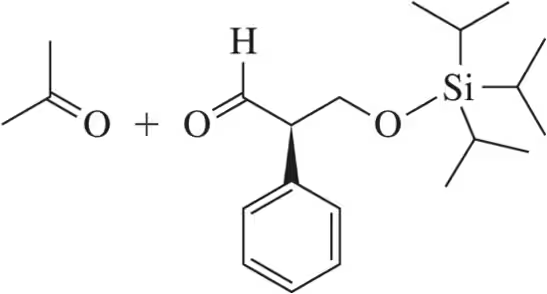
Propose a synthesis of the carbonyl(s) using the (i) ozonolysis pathways.
(b)

Verified step by step guidance
1
Identify the starting alkene: Begin by determining the alkene that, upon ozonolysis, will yield the desired carbonyl compound(s). Consider the structure of the target carbonyl(s) and work backwards to deduce the possible alkene precursor.
Draw the structure of the alkene: Once the starting alkene is identified, draw its structure. Ensure that the double bond is positioned such that its cleavage will lead to the formation of the desired carbonyl compounds.
Apply the ozonolysis reaction: Ozonolysis involves the reaction of the alkene with ozone (O3) followed by a reductive workup, typically using zinc (Zn) and acetic acid (CH3COOH) or dimethyl sulfide (DMS). Write the reaction equation showing the alkene reacting with ozone.
Predict the products: Upon completion of the ozonolysis reaction, the double bond in the alkene is cleaved, resulting in the formation of two carbonyl groups. Draw the structures of these carbonyl products.
Verify the synthesis: Check that the carbonyl products obtained from the ozonolysis match the target carbonyl(s) specified in the problem. Ensure that the synthesis pathway is logical and feasible.

Verified video answer for a similar problem:

This video solution was recommended by our tutors as helpful for the problem above.
Video duration:
3m
Was this helpful?

Key Concepts

Here are the essential concepts you must grasp in order to answer the question correctly.

Ozonolysis

Ozonolysis is a reaction where ozone (O3) cleaves alkenes or alkynes to form carbonyl compounds such as aldehydes, ketones, or carboxylic acids. The reaction involves the formation of an ozonide intermediate, which is then reduced to yield the carbonyl products. Understanding the mechanism and the types of products formed is crucial for proposing a synthesis pathway using ozonolysis.
Recommended video:
Guided course
06:30
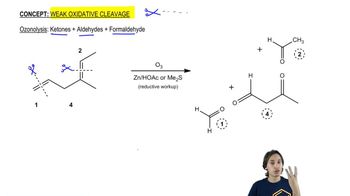
General properties of ozonolysis.

Carbonyl Compounds

Carbonyl compounds are organic molecules containing a carbon-oxygen double bond. They include aldehydes, ketones, carboxylic acids, and their derivatives. The reactivity of the carbonyl group, due to its polar nature, makes it a key functional group in organic synthesis. Recognizing the structure and reactivity of carbonyl compounds is essential for designing synthesis routes.
Recommended video:
Guided course
01:40
Defining meso compounds.

Synthesis Pathways

Synthesis pathways in organic chemistry involve a series of chemical reactions to construct a desired compound from simpler starting materials. This requires understanding the reactivity and compatibility of functional groups, as well as the conditions needed for each reaction step. Proposing a synthesis involves selecting appropriate reactions and intermediates to efficiently achieve the target molecule.
Recommended video:
2:13
Energy Production In Biochemical Pathways Concept 1