Ch. 13 - Alcohols, Ethers and Related Compounds: Substitution and Elimination
Mullins - Organic Chemistry: A Learner Centered Approach 1st Edition
Mullins1st EditionOrganic Chemistry: A Learner Centered ApproachISBN: 9780137566471Not the one you use?Change textbook
Chapter 12, Problem 24b

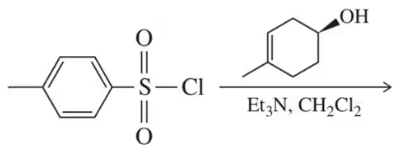
Predict the product of the following sulfonylation reactions.
(b)

Verified step by step guidance
1
Identify the reactants involved in the sulfonylation reaction. The first reactant is a sulfonyl chloride, specifically para-toluenesulfonyl chloride, and the second reactant is a cyclohexanol derivative.
Recognize the role of the base, triethylamine (Et3N), in the reaction. It is used to neutralize the hydrochloric acid (HCl) byproduct formed during the reaction, facilitating the formation of the sulfonate ester.
Understand the mechanism of the reaction. The hydroxyl group (OH) on the cyclohexanol acts as a nucleophile and attacks the sulfur atom of the sulfonyl chloride, leading to the displacement of the chloride ion (Cl-).
Consider the stereochemistry of the reaction. Since the hydroxyl group is attached to a cyclohexane ring, the reaction may proceed with retention of configuration, depending on the reaction conditions.
Predict the product of the reaction. The product will be a sulfonate ester, where the cyclohexanol derivative is now bonded to the sulfonyl group, forming a cyclohexyl para-toluenesulfonate.

Verified video answer for a similar problem:

This video solution was recommended by our tutors as helpful for the problem above.
Was this helpful?

Key Concepts

Here are the essential concepts you must grasp in order to answer the question correctly.

Sulfonylation

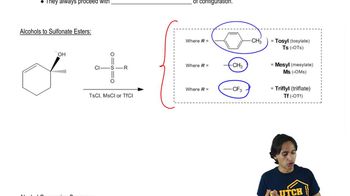
Sulfonylation is a chemical reaction that introduces a sulfonyl group (SO2) into a molecule. This process typically involves the reaction of a sulfonyl chloride with an organic compound, often an aromatic ring or an alcohol, leading to the formation of sulfonate esters or sulfonamides. Understanding the mechanism of this reaction is crucial for predicting the products formed.
Recommended video:
Guided course
05:33
Learning the mechanism of Sulfonyl Chlorides.

Electrophilic Aromatic Substitution

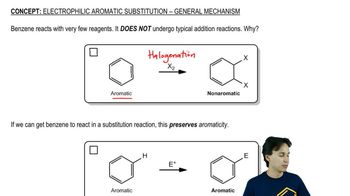
Electrophilic aromatic substitution (EAS) is a fundamental reaction in organic chemistry where an electrophile replaces a hydrogen atom on an aromatic ring. This reaction is essential for understanding how sulfonyl groups can be introduced into aromatic compounds, as the sulfonyl group acts as an electrophile. Recognizing the conditions and directing effects of substituents on the aromatic ring is vital for predicting the outcome of the reaction.
Recommended video:

Reaction Mechanism

A reaction mechanism describes the step-by-step process by which reactants are converted into products. In the context of sulfonylation, understanding the mechanism helps in predicting the structure of the final product, including the role of intermediates and the transition states. Familiarity with mechanisms allows chemists to anticipate the behavior of different substrates under varying conditions.
Recommended video:
Guided course
02:16
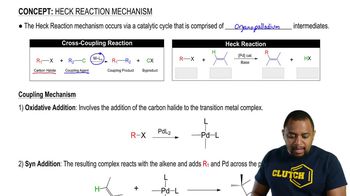
Heck Reaction Mechanism