Ch. 13 - Alcohols, Ethers and Related Compounds: Substitution and Elimination
Mullins - Organic Chemistry: A Learner Centered Approach 1st Edition
Mullins1st EditionOrganic Chemistry: A Learner Centered ApproachISBN: 9780137566471Not the one you use?Change textbook
Chapter 12, Problem 24a

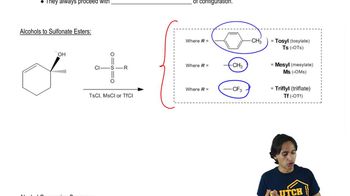
Predict the product of the following sulfonylation reactions.
(a) Chemical reaction: cyclopentanol with TsCl and Et3N in CH2Cl2, predicting sulfonylation product.

Verified step by step guidance
1
Identify the functional groups present in the reactants. Sulfonylation typically involves a sulfonyl chloride (R-SO2-Cl) reacting with an alcohol or amine.
Determine the nucleophile in the reaction. In sulfonylation, the nucleophile is usually the oxygen atom in an alcohol or the nitrogen atom in an amine.
Consider the mechanism of the reaction. Sulfonylation involves the nucleophilic attack on the sulfur atom of the sulfonyl chloride, leading to the displacement of the chloride ion.
Predict the structure of the product. The nucleophile will form a bond with the sulfur atom, resulting in the formation of a sulfonate ester (if an alcohol is used) or a sulfonamide (if an amine is used).
Verify the stereochemistry and regiochemistry of the product, if applicable. Ensure that the product is correctly drawn with the appropriate orientation and connectivity.

Verified video answer for a similar problem:

This video solution was recommended by our tutors as helpful for the problem above.
Video duration:
2m
Was this helpful?

Key Concepts

Here are the essential concepts you must grasp in order to answer the question correctly.

Sulfonylation Reaction

Sulfonylation is a chemical reaction where a sulfonyl group is introduced into an organic molecule. This typically involves the reaction of an organic compound with a sulfonyl chloride in the presence of a base, resulting in the formation of a sulfonamide or sulfone. Understanding the mechanism and conditions of sulfonylation is crucial for predicting the products of such reactions.
Recommended video:
Guided course
05:33
Learning the mechanism of Sulfonyl Chlorides.

Functional Groups

Functional groups are specific groups of atoms within molecules that are responsible for the characteristic chemical reactions of those molecules. In sulfonylation, recognizing the functional groups present in the reactants, such as amines or alcohols, is essential as they determine the site of reaction and the type of product formed, such as sulfonamides or sulfones.
Recommended video:
Guided course
02:36
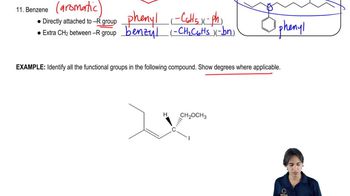
Identifying Functional Groups

Reaction Mechanism

The reaction mechanism describes the step-by-step process by which reactants are transformed into products. In sulfonylation, the mechanism often involves nucleophilic attack on the sulfonyl chloride by a nucleophile, followed by the formation of a stable product. Understanding the mechanism helps in predicting the structure and properties of the reaction product.
Recommended video:
Guided course
02:16
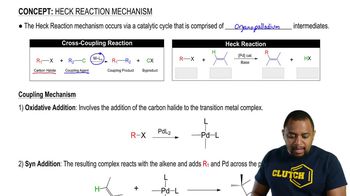
Heck Reaction Mechanism