Ch. 13 - Alcohols, Ethers and Related Compounds: Substitution and Elimination
Mullins - Organic Chemistry: A Learner Centered Approach 1st Edition
Mullins1st EditionOrganic Chemistry: A Learner Centered ApproachISBN: 9780137566471Not the one you use?Change textbook
Chapter 12, Problem 40c

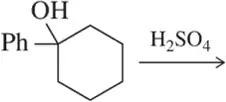
Predict the major product of the following elimination reactions.
(c) Chemical structure showing a cyclohexane with a hydroxyl group and a phenyl group, indicating a dehydration reaction with sulfuric acid.

Verified step by step guidance
1
Step 1: Identify the type of elimination reaction (E1 or E2). This depends on the reaction conditions, such as the presence of a strong base (favoring E2) or a weak base and polar protic solvent (favoring E1). Analyze the given reaction conditions to determine the mechanism.
Step 2: Locate the leaving group in the molecule. In elimination reactions, the leaving group departs, creating a carbocation intermediate (E1) or directly facilitating the elimination process (E2).
Step 3: Determine the β-hydrogens available for elimination. These are hydrogens attached to the carbon atoms adjacent to the carbon bearing the leaving group. Identify all possible β-hydrogens.
Step 4: Apply Zaitsev's rule to predict the major product. Zaitsev's rule states that the most substituted alkene (the one with the greatest number of alkyl groups attached to the double-bonded carbons) is usually the major product in elimination reactions.
Step 5: Consider steric hindrance and reaction conditions. If the base is bulky, the reaction may favor the formation of the less substituted alkene (Hofmann product). Use this information to finalize the prediction of the major product.

Verified video answer for a similar problem:

This video solution was recommended by our tutors as helpful for the problem above.
Video duration:
7m
Was this helpful?

Key Concepts

Here are the essential concepts you must grasp in order to answer the question correctly.

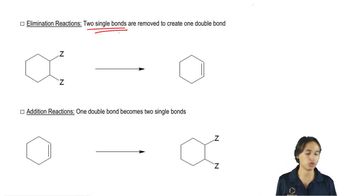
Elimination Reactions

Elimination reactions are a type of organic reaction where two substituents are removed from a molecule, resulting in the formation of a double bond or a ring structure. These reactions typically involve the loss of a leaving group and a hydrogen atom from adjacent carbon atoms, leading to alkenes or alkynes as products. Understanding the mechanism and conditions that favor elimination is crucial for predicting the major products.
Recommended video:
Guided course
00:40
Recognizing Elimination Reactions.

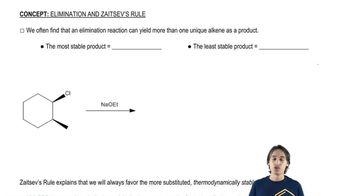
Zaitsev's Rule

Zaitsev's Rule states that in elimination reactions, the more substituted alkene is generally the major product. This is because more substituted alkenes are more stable due to hyperconjugation and the inductive effect. Recognizing the stability of potential alkene products helps in predicting which product will dominate in elimination reactions.
Recommended video:
Guided course
01:18
Defining Zaitsev’s Rule

Regioselectivity

Regioselectivity refers to the preference of a chemical reaction to yield one structural isomer over others when multiple products are possible. In elimination reactions, regioselectivity is influenced by factors such as sterics and electronic effects, which determine the most favorable pathway for the reaction. Understanding regioselectivity is essential for accurately predicting the major product in elimination reactions.
Recommended video:
Guided course
05:09
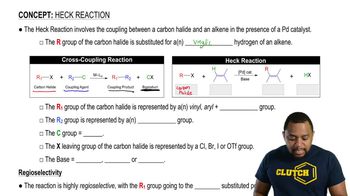
Heck Reaction