Ch. 13 - Alcohols, Ethers and Related Compounds: Substitution and Elimination
Mullins - Organic Chemistry: A Learner Centered Approach 1st Edition
Mullins1st EditionOrganic Chemistry: A Learner Centered ApproachISBN: 9780137566471Not the one you use?Change textbook
Chapter 12, Problem 41c

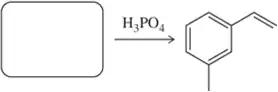
Identify the alcohol(s) that would produce the following alkenes under the given conditions.
(c) Reaction diagram showing dehydration of an alcohol to form an alkene using phosphoric acid as a catalyst.

Verified step by step guidance
1
Step 1: Recognize the reaction type. The given reaction involves the dehydration of an alcohol to form an alkene using concentrated sulfuric acid (H₂SO₄). This is an elimination reaction (E1 mechanism).
Step 2: Analyze the structure of the alkene product. The product is a substituted cyclopentene with a double bond between the cyclopentane ring and the isopropyl group. This suggests that the alcohol precursor must have a hydroxyl group (-OH) attached to the carbon that loses water during the reaction.
Step 3: Determine the alcohol precursor. To form the given alkene, the alcohol must have the hydroxyl group on the carbon adjacent to the cyclopentane ring and the isopropyl group. This ensures that the double bond forms in the correct position during elimination.
Step 4: Consider regioselectivity and stability. The major product of an E1 reaction is typically the more stable alkene, which follows Zaitsev's rule. The double bond forms in the position that results in the most substituted alkene, as seen in the product structure.
Step 5: Identify the alcohol(s). Based on the structure of the alkene, the alcohol precursor is likely 1-(1-hydroxyethyl)cyclopentane or a similar compound where the hydroxyl group is positioned to allow elimination and formation of the observed alkene.

Verified video answer for a similar problem:

This video solution was recommended by our tutors as helpful for the problem above.
Was this helpful?

Key Concepts

Here are the essential concepts you must grasp in order to answer the question correctly.

Alcohols and Alkenes

Alcohols are organic compounds containing one or more hydroxyl (-OH) groups, while alkenes are hydrocarbons that contain at least one carbon-carbon double bond. The conversion of alcohols to alkenes typically involves dehydration, where water is removed, leading to the formation of a double bond. Understanding the structure of both alcohols and alkenes is crucial for predicting the products of such reactions.
Recommended video:
2:09
Alkene Metathesis Concept 1

Dehydration Reaction

Dehydration reactions involve the removal of a water molecule from a compound, often resulting in the formation of a double bond. In the context of alcohols, this process can be facilitated by heat and the presence of an acid catalyst, which helps to protonate the hydroxyl group, making it a better leaving group. Recognizing the conditions that favor dehydration is essential for determining which alcohols can yield specific alkenes.
Recommended video:
Guided course
01:23
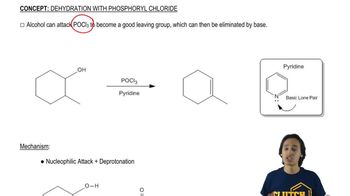
General Reaction of Dehydration with POCl3

Regioselectivity and Zaitsev's Rule

Regioselectivity refers to the preference of a chemical reaction to yield one structural isomer over others. Zaitsev's Rule states that in elimination reactions, the more substituted alkene (the one with more alkyl groups attached to the double bond) is typically favored. This principle is important when predicting which alcohols will produce specific alkenes, as it guides the expected outcome based on the stability of the resulting alkenes.
Recommended video:
Guided course
01:18
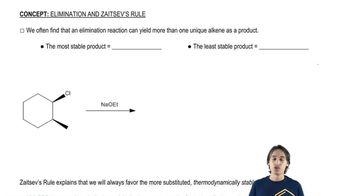
Defining Zaitsev’s Rule