Ch. 13 - Alcohols, Ethers and Related Compounds: Substitution and Elimination
Mullins - Organic Chemistry: A Learner Centered Approach 1st Edition
Mullins1st EditionOrganic Chemistry: A Learner Centered ApproachISBN: 9780137566471Not the one you use?Change textbook
Chapter 12, Problem 101c

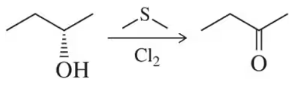
Draw a mechanism for the following oxidation reactions.
(c)

Verified step by step guidance
1
Identify the starting material and the product: The starting material is a secondary alcohol, and the product is a ketone. This indicates an oxidation reaction where the alcohol is converted to a carbonyl group.
Recognize the reagent: The reagent is thionyl chloride (SOCl2), which is commonly used to convert alcohols to alkyl chlorides. However, in this context, it is used to facilitate the oxidation of the alcohol to a ketone.
Understand the mechanism: The reaction likely involves the formation of an intermediate chlorosulfite ester. The alcohol oxygen attacks the sulfur atom of thionyl chloride, leading to the formation of this intermediate.
Formation of the chlorosulfite ester: The hydroxyl group of the alcohol attacks the sulfur atom in thionyl chloride, displacing a chloride ion and forming a chlorosulfite ester intermediate.
Elimination to form the ketone: The chlorosulfite ester undergoes elimination, where the chloride ion acts as a leaving group, resulting in the formation of a carbonyl group (ketone) and the release of sulfur dioxide (SO2) and hydrochloric acid (HCl) as byproducts.

Verified video answer for a similar problem:

This video solution was recommended by our tutors as helpful for the problem above.
Video duration:
5m
Was this helpful?

Key Concepts

Here are the essential concepts you must grasp in order to answer the question correctly.

Oxidation Reactions

Oxidation reactions involve the loss of electrons or an increase in oxidation state by a molecule, atom, or ion. In organic chemistry, this often pertains to the conversion of alcohols to carbonyl compounds (aldehydes or ketones) or carboxylic acids. Understanding the specific reagents and conditions that facilitate these transformations is crucial for drawing accurate reaction mechanisms.
Recommended video:
Guided course
03:20
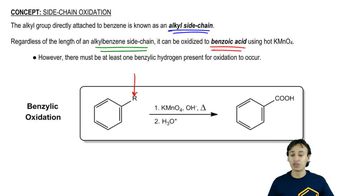
Benzylic Oxidation

Reaction Mechanisms

A reaction mechanism is a step-by-step description of how a chemical reaction occurs at the molecular level. It outlines the sequence of bond-breaking and bond-forming events, including intermediates and transition states. For oxidation reactions, mechanisms often involve the formation of reactive intermediates, such as radicals or carbocations, which are essential for understanding the overall process.
Recommended video:
Guided course
02:16
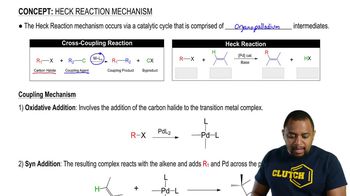
Heck Reaction Mechanism

Functional Group Transformations

Functional group transformations refer to the chemical changes that occur to specific groups within organic molecules during reactions. In the context of oxidation, this typically involves the conversion of alcohols (–OH) to carbonyls (C=O) or carboxylic acids (–COOH). Recognizing these transformations is vital for predicting the products of oxidation reactions and for accurately illustrating their mechanisms.
Recommended video:
Guided course
02:36
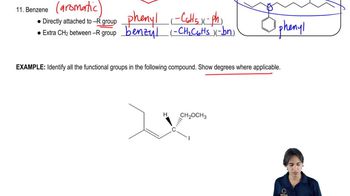
Identifying Functional Groups