Ch. 13 - Alcohols, Ethers and Related Compounds: Substitution and Elimination
Mullins - Organic Chemistry: A Learner Centered Approach 1st Edition
Mullins1st EditionOrganic Chemistry: A Learner Centered ApproachISBN: 9780137566471Not the one you use?Change textbook
Chapter 12, Problem 101b

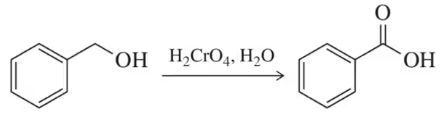
Draw a mechanism for the following oxidation reactions.
(b)

Verified step by step guidance
1
Identify the starting material and the reagent: The starting material is benzyl alcohol, and the reagent is chromic acid (H2CrO4) in water, which is a strong oxidizing agent.
Recognize the functional group transformation: The reaction involves the oxidation of a primary alcohol to a carboxylic acid.
Protonation of the alcohol: The hydroxyl group of benzyl alcohol is protonated by the acidic environment, making it a better leaving group.
Formation of the chromate ester: The alcohol oxygen attacks the chromium atom in chromic acid, forming a chromate ester intermediate.
Elimination and oxidation: The chromate ester undergoes elimination to form a carbonyl group, and further oxidation leads to the formation of the carboxylic acid, benzoic acid.

Verified video answer for a similar problem:

This video solution was recommended by our tutors as helpful for the problem above.
Was this helpful?

Key Concepts

Here are the essential concepts you must grasp in order to answer the question correctly.

Oxidation Reactions

Oxidation reactions involve the loss of electrons or an increase in oxidation state by a molecule, atom, or ion. In organic chemistry, this often pertains to the conversion of alcohols to carbonyl compounds (aldehydes or ketones) or carboxylic acids. Understanding the specific reagents and conditions that facilitate these transformations is crucial for drawing accurate reaction mechanisms.
Recommended video:
Guided course
03:20
Benzylic Oxidation

Reaction Mechanisms

A reaction mechanism is a step-by-step description of how a chemical reaction occurs, detailing the bond-breaking and bond-forming processes. It includes intermediates, transition states, and the sequence of elementary steps. For oxidation reactions, mechanisms often illustrate the role of oxidizing agents and the movement of electrons, which is essential for accurately depicting the transformation.
Recommended video:
Guided course
02:16
Heck Reaction Mechanism

Functional Groups

Functional groups are specific groups of atoms within molecules that are responsible for the characteristic chemical reactions of those molecules. In oxidation reactions, common functional groups include alcohols, aldehydes, and ketones. Recognizing these groups helps predict the products of oxidation and understand how the structure of a molecule influences its reactivity.
Recommended video:
Guided course
02:36
Identifying Functional Groups