Ch. 12 - Substitution and Elimination: Reactions of Haloalkanes
Mullins - Organic Chemistry: A Learner Centered Approach 1st Edition
Mullins1st EditionOrganic Chemistry: A Learner Centered ApproachISBN: 9780137566471Not the one you use?Change textbook
Chapter 11, Problem 26

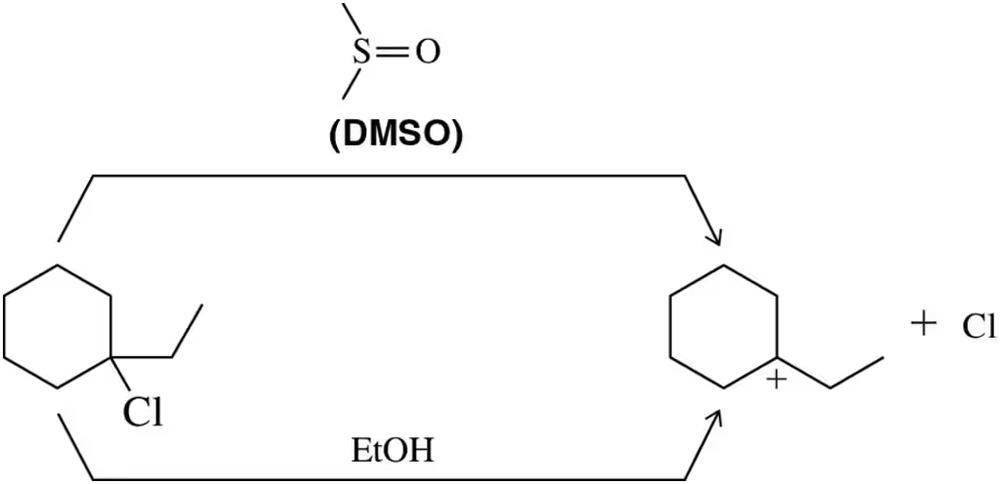
Which reaction would be faster, the one with DMSO as the solvent or the one with ethanol (EtOH)?
Comparison of SN1 reactions in DMSO and ethanol solvents, showing reactants and products with arrows indicating reaction pathways.

Verified step by step guidance
1
Step 1: Understand the role of the solvent in a chemical reaction. Solvents can influence the rate of a reaction by stabilizing intermediates, affecting nucleophilicity, or altering the reaction mechanism. DMSO (dimethyl sulfoxide) is an aprotic solvent, while ethanol (EtOH) is a protic solvent.
Step 2: Recall the difference between protic and aprotic solvents. Protic solvents, like ethanol, can donate hydrogen bonds and stabilize ions, particularly nucleophiles, by forming hydrogen bonds. Aprotic solvents, like DMSO, do not donate hydrogen bonds and instead stabilize cations, leaving nucleophiles more reactive.
Step 3: Consider the type of reaction. For example, in an SN2 reaction, aprotic solvents like DMSO are preferred because they do not hinder the nucleophile, allowing it to attack the electrophile more effectively. In contrast, protic solvents like ethanol can slow down SN2 reactions by stabilizing the nucleophile through hydrogen bonding.
Step 4: Evaluate the solvent's impact on the reaction mechanism. If the reaction is SN1, protic solvents like ethanol are often better because they stabilize the carbocation intermediate formed during the rate-determining step. Aprotic solvents like DMSO are less effective in stabilizing carbocations, which can slow down SN1 reactions.
Step 5: Conclude that the reaction rate depends on the mechanism (SN1 or SN2) and the solvent's ability to stabilize intermediates or nucleophiles. For an SN2 reaction, DMSO would likely lead to a faster reaction, while for an SN1 reaction, ethanol might be faster. Analyze the specific reaction to determine the mechanism and solvent compatibility.

Verified video answer for a similar problem:

This video solution was recommended by our tutors as helpful for the problem above.
Video duration:
2m
Was this helpful?

Key Concepts

Here are the essential concepts you must grasp in order to answer the question correctly.

Solvent Polarity

The polarity of a solvent significantly influences the rate of chemical reactions. DMSO (dimethyl sulfoxide) is a highly polar aprotic solvent, which can stabilize charged intermediates and transition states, often leading to faster reaction rates. In contrast, ethanol is a polar protic solvent that can form hydrogen bonds, which may hinder the reaction rate for certain mechanisms.
Recommended video:
Guided course
01:16
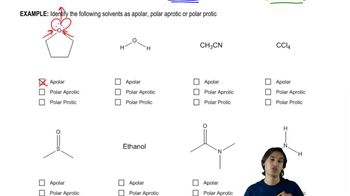
Identification of polarity in solvents

Nucleophilicity and Electrophilicity

The reactivity of nucleophiles and electrophiles is crucial in determining reaction rates. In polar aprotic solvents like DMSO, nucleophiles are generally more reactive because they are less solvated compared to those in polar protic solvents like ethanol. This difference can lead to faster reactions in DMSO if the mechanism involves nucleophilic attack.
Recommended video:
Guided course
03:
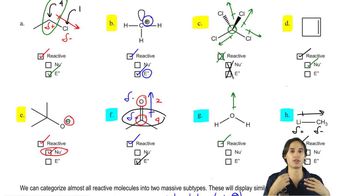
Nucleophile or Electrophile

Reaction Mechanism

The specific mechanism of a reaction (e.g., SN1, SN2, E1, E2) plays a vital role in how solvent choice affects reaction speed. For example, SN2 reactions benefit from polar aprotic solvents that enhance nucleophilicity, while SN1 reactions may be favored in polar protic solvents due to better stabilization of carbocation intermediates. Understanding the mechanism helps predict which solvent will lead to a faster reaction.
Recommended video:
Guided course
02:16
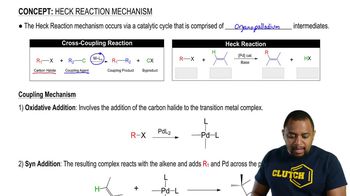
Heck Reaction Mechanism