Ch. 12 - Substitution and Elimination: Reactions of Haloalkanes
Mullins - Organic Chemistry: A Learner Centered Approach 1st Edition
Mullins1st EditionOrganic Chemistry: A Learner Centered ApproachISBN: 9780137566471Not the one you use?Change textbook
Chapter 11, Problem 25b

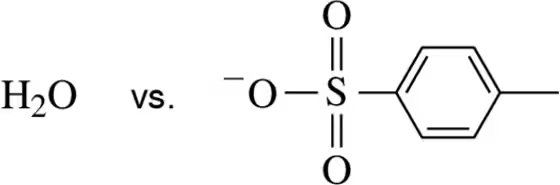
Which of the following is the better leaving group in a polar aprotic solvent?
(b) Comparison of H2O and a sulfonate leaving group structure in a polar aprotic solvent.

Verified step by step guidance
1
Identify the concept of a leaving group: A leaving group is an atom or group of atoms that can depart with a pair of electrons during a chemical reaction. A good leaving group is typically stable after leaving the molecule.
Understand the role of the solvent: In a polar aprotic solvent, the solvent does not donate hydrogen bonds to stabilize ions. This means the leaving group's stability in its ionic form is crucial for determining its effectiveness.
Compare the leaving groups: Water (H₂O) and hydroxide ion (OH⁻) are the two species to consider. Water is neutral, while hydroxide is negatively charged. A neutral species is generally more stable than a charged one, making it a better leaving group.
Analyze the stability of the leaving group after departure: When H₂O leaves, it remains as a stable, neutral molecule. In contrast, OH⁻ is less stable due to its negative charge, especially in a polar aprotic solvent where it is not well-solvated.
Conclude based on the above analysis: H₂O is the better leaving group in a polar aprotic solvent because it is more stable after leaving the molecule compared to OH⁻.

Verified video answer for a similar problem:

This video solution was recommended by our tutors as helpful for the problem above.
Video duration:
1m
Was this helpful?

Key Concepts

Here are the essential concepts you must grasp in order to answer the question correctly.

Leaving Groups

Leaving groups are atoms or groups of atoms that can depart from a molecule during a chemical reaction, taking with them a pair of electrons. The ability of a leaving group to stabilize the negative charge after departure is crucial; better leaving groups are typically weaker bases. Common examples include halides and water, with water being a relatively good leaving group due to its ability to stabilize the resulting hydroxide ion.
Recommended video:
Guided course
07:22
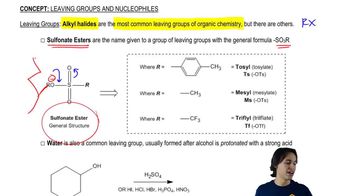
The 3 important leaving groups to know.

Polar Aprotic Solvents

Polar aprotic solvents are solvents that have a significant dipole moment but do not have hydrogen atoms bonded to electronegative atoms, which means they cannot form hydrogen bonds. These solvents can stabilize cations but not anions, making them favorable for reactions involving nucleophiles. Examples include acetone and DMSO, which enhance the reactivity of nucleophiles by solvation without hindering their ability to attack electrophiles.
Recommended video:
Guided course
00:37
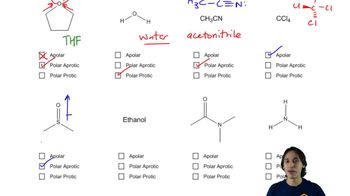
Identification of polarity in solvents

Nucleophilicity and Basicity

Nucleophilicity refers to the ability of a species to donate an electron pair to an electrophile, while basicity is a measure of how readily a species accepts protons. In polar aprotic solvents, nucleophilicity is often enhanced for anions because these solvents do not solvate anions as effectively as protic solvents do. This distinction is important when evaluating the effectiveness of leaving groups, as better leaving groups correlate with stronger nucleophiles in these solvent conditions.
Recommended video:
Guided course
06:21
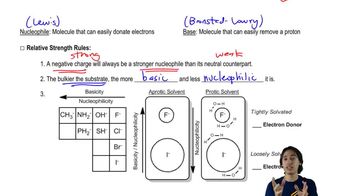
Understanding the difference between basicity and nucleophilicity.