The introduction of elimination reactions provides a second way to synthesize alkynes in a two-step process starting with an alkene. Suggest a mechanism for both steps of this process.
Ch. 12 - Substitution and Elimination: Reactions of Haloalkanes

Mullins1st EditionOrganic Chemistry: A Learner Centered ApproachISBN: 9780137566471Not the one you use?Change textbook
All textbooks
Mullins 1st Edition
Ch. 12 - Substitution and Elimination: Reactions of Haloalkanes
Problem 65
Mullins 1st Edition
Ch. 12 - Substitution and Elimination: Reactions of Haloalkanes
Problem 65Chapter 11, Problem 65
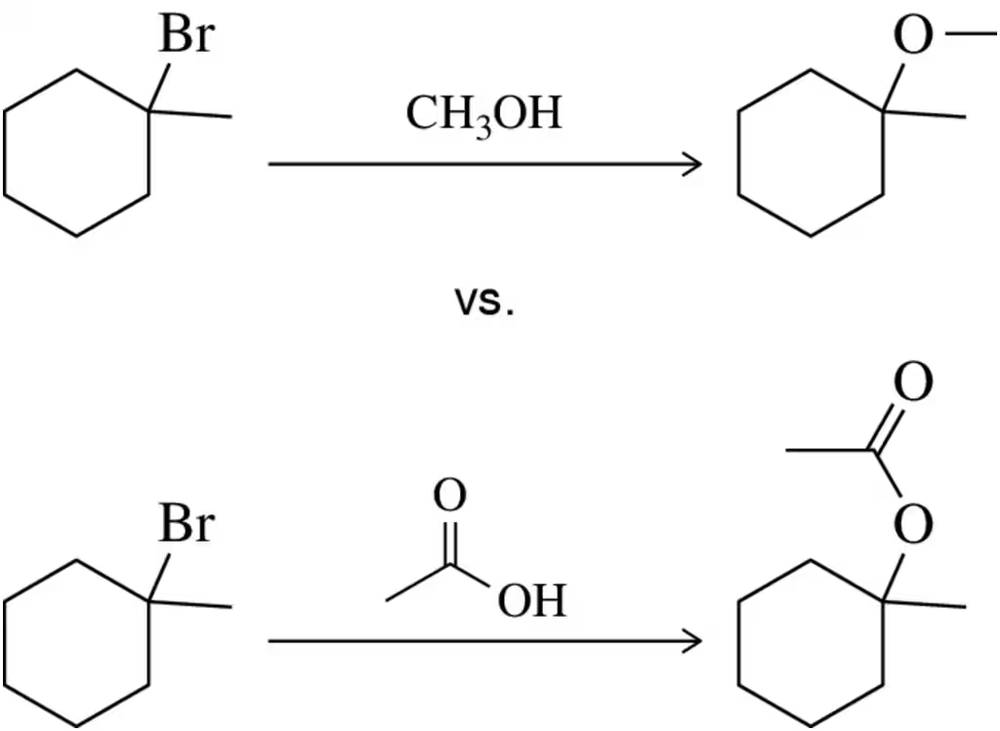
Which of the following substitution reactions would you expect to occur more quickly? Explain your answer.

Verified step by step guidance1
Step 1: Understand the type of substitution reaction being discussed. Substitution reactions can be classified as SN1 (unimolecular nucleophilic substitution) or SN2 (bimolecular nucleophilic substitution). The reaction rate depends on the mechanism, the structure of the substrate, the nucleophile, the leaving group, and the solvent.
Step 2: Analyze the structure of the substrates in the given reactions. For SN1 reactions, the rate depends on the stability of the carbocation intermediate formed after the leaving group departs. For SN2 reactions, the rate depends on steric hindrance around the carbon undergoing substitution.
Step 3: Evaluate the leaving group in each reaction. A good leaving group (e.g., halides like I⁻, Br⁻, Cl⁻) stabilizes the negative charge after leaving, which can accelerate the reaction. Compare the leaving groups in the two reactions to determine which one is better.
Step 4: Consider the nucleophile and solvent. For SN2 reactions, a strong nucleophile and polar aprotic solvent (e.g., acetone, DMSO) favor faster reactions. For SN1 reactions, a polar protic solvent (e.g., water, alcohols) stabilizes the carbocation intermediate and speeds up the reaction.
Step 5: Compare the two reactions based on the above factors (substrate structure, leaving group, nucleophile, and solvent). Determine which reaction has conditions more favorable for the substitution mechanism and explain why it would occur more quickly.

Verified video answer for a similar problem:
This video solution was recommended by our tutors as helpful for the problem above.
Video duration:
2mWas this helpful?
Key Concepts
Here are the essential concepts you must grasp in order to answer the question correctly.
Nucleophilic Substitution Reactions
Nucleophilic substitution reactions involve the replacement of a leaving group in a molecule by a nucleophile. The rate of these reactions can depend on factors such as the strength of the nucleophile, the nature of the leaving group, and the solvent used. Understanding the mechanism, whether it follows an SN1 or SN2 pathway, is crucial for predicting the reaction's speed.
Recommended video:
Guided course
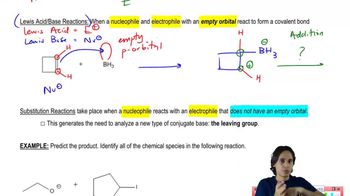
Nucleophiles and Electrophiles can react in Substitution Reactions.
SN1 vs. SN2 Mechanisms
SN1 reactions are unimolecular and involve a two-step mechanism where the leaving group departs first, forming a carbocation intermediate. In contrast, SN2 reactions are bimolecular and occur in a single step, where the nucleophile attacks the substrate simultaneously as the leaving group departs. The steric hindrance and the stability of the carbocation significantly influence the reaction rates of these mechanisms.
Recommended video:
Guided course
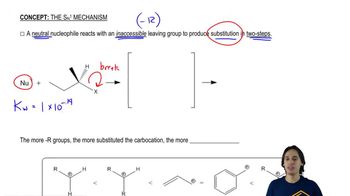
Drawing the SN1 Mechanism
Factors Affecting Reaction Rate
The rate of nucleophilic substitution reactions is influenced by several factors, including the nature of the substrate (primary, secondary, or tertiary), the strength and concentration of the nucleophile, and the quality of the leaving group. Additionally, solvent effects can play a significant role, with polar protic solvents favoring SN1 and polar aprotic solvents favoring SN2 reactions. Understanding these factors is essential for predicting which reaction will occur more quickly.
Recommended video:
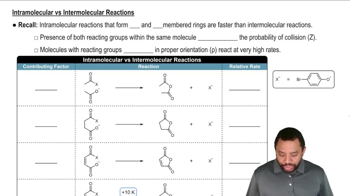
Rates of Intramolecular Reactions Concept 2
Related Practice
Textbook Question
5
views
Textbook Question
Give a mechanism for the following substitution and elimination reactions.
(b)
1
views
Textbook Question
When the reaction scheme in Assessment 12.63 is done on a monosubstituted alkene, at least three equivalents of base are needed. Reacting the product of step 2 with D–Cl (D is an isotope of H) incorporates deuterium at the terminal carbon. Explain these two observations.
Textbook Question
Give a mechanism for the following substitution and elimination reactions.
(c)
3
views
Textbook Question
Acetylide alkylation, from Assessment 12.61, fails to give the desired product with 2° haloalkanes. Why? What is the actual product of this reaction?
2
views
Textbook Question
Give a mechanism for the following substitution and elimination reactions.
(a)
1
views