Textbook Question
Which of the following substitution reactions would you expect to occur more quickly? Explain your answer.
1
views

 Mullins 1st EditionCh. 12 - Substitution and Elimination: Reactions of HaloalkanesProblem 62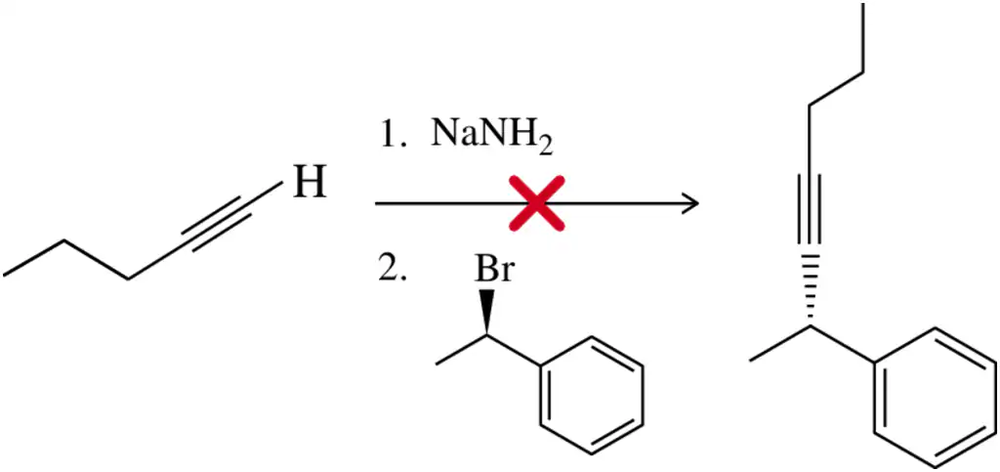
 Verified step by step guidance
 08:27
08:27
 08:33
08:33 00:40
00:40Which of the following substitution reactions would you expect to occur more quickly? Explain your answer.
The introduction of elimination reactions provides a second way to synthesize alkynes in a two-step process starting with an alkene. Suggest a mechanism for both steps of this process.
Suggest a bromoalkane and the conditions necessary to produce the alkenes shown.
(a)
In Chapter 10, you learned how to make an alkyne by acetylide alkylation with a 1° haloalkane. Suggest a mechanism by which this reaction occurs.
When the reaction scheme in Assessment 12.63 is done on a monosubstituted alkene, at least three equivalents of base are needed. Reacting the product of step 2 with D–Cl (D is an isotope of H) incorporates deuterium at the terminal carbon. Explain these two observations.
Suggest a bromoalkane and the conditions necessary to produce the alkenes shown.
(b)