Ch. 12 - Substitution and Elimination: Reactions of Haloalkanes
Mullins - Organic Chemistry: A Learner Centered Approach 1st Edition
Mullins1st EditionOrganic Chemistry: A Learner Centered ApproachISBN: 9780137566471Not the one you use?Change textbook
Chapter 11, Problem 69

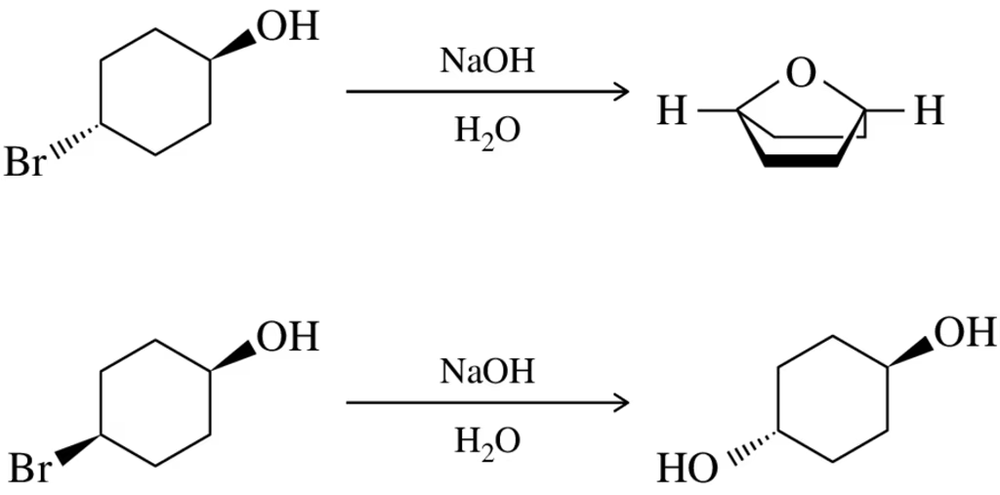
When trans-4-bromocyclohexanol is treated with base, an intramolecular substitution reaction occurs to give a cyclic ether. This product does not form when cis-4-bromocyclohexanol is reacted under the same conditions. Explain these observations.
Comparison of intramolecular substitution reactions of trans- and cis-4-bromocyclohexanol with NaOH.

Verified step by step guidance
1
Step 1: Analyze the stereochemistry of trans-4-bromocyclohexanol and cis-4-bromocyclohexanol. In the trans isomer, the bromine and hydroxyl groups are on opposite sides of the cyclohexane ring, while in the cis isomer, they are on the same side.
Step 2: Consider the reaction mechanism. The base (NaOH) deprotonates the hydroxyl group, forming an alkoxide ion. This alkoxide ion is a strong nucleophile and can attack the carbon bonded to the bromine atom in an intramolecular substitution reaction (S_N2 mechanism).
Step 3: Evaluate the geometry required for the S_N2 reaction. For the intramolecular substitution to occur, the nucleophile (alkoxide) and the leaving group (bromine) must be in an anti-periplanar arrangement. This arrangement is possible in the trans isomer but not in the cis isomer due to steric and geometric constraints.
Step 4: Explain why the cyclic ether forms only in the trans isomer. In the trans isomer, the anti-periplanar geometry allows the alkoxide to attack the carbon bonded to bromine, leading to the formation of a five-membered cyclic ether. In the cis isomer, this geometry is not achievable, so no cyclic ether is formed.
Step 5: Summarize the observations. The stereochemistry of the starting material determines the outcome of the reaction. The trans isomer undergoes intramolecular substitution to form a cyclic ether, while the cis isomer does not react under the same conditions due to the lack of proper geometry for the S_N2 mechanism.

Verified video answer for a similar problem:

This video solution was recommended by our tutors as helpful for the problem above.
Was this helpful?

Key Concepts

Here are the essential concepts you must grasp in order to answer the question correctly.

Intramolecular Substitution Reactions

Intramolecular substitution reactions occur when a nucleophile attacks an electrophile within the same molecule, leading to the formation of a cyclic structure. In the case of trans-4-bromocyclohexanol, the hydroxyl group can effectively displace the bromine atom, resulting in a cyclic ether. This process is favored when the nucleophile and electrophile are in close proximity, which is facilitated by the molecule's conformation.
Recommended video:
2:29
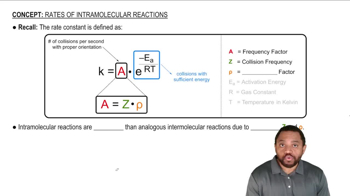
Rates of Intramolecular Reactions Concept 1

Cis vs. Trans Isomerism

Cis and trans isomerism refers to the spatial arrangement of substituents around a double bond or a ring structure. In trans-4-bromocyclohexanol, the bromine and hydroxyl groups are positioned on opposite sides, allowing for a favorable orientation for intramolecular attack. Conversely, in cis-4-bromocyclohexanol, both groups are on the same side, which hinders the nucleophilic attack necessary for forming a cyclic ether.
Recommended video:
Guided course
00:44
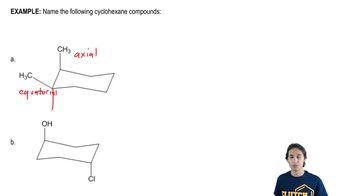
Is the following cyclohexane cis or trans?

Base-Catalyzed Reactions

Base-catalyzed reactions involve the use of a base, such as sodium hydroxide, to facilitate the reaction mechanism. In this context, the base deprotonates the hydroxyl group, enhancing its nucleophilicity and enabling it to attack the electrophilic carbon bonded to the bromine. This step is crucial for the formation of the cyclic ether in trans-4-bromocyclohexanol, while the steric hindrance in the cis isomer prevents this reaction from occurring.
Recommended video:
Guided course
01:57
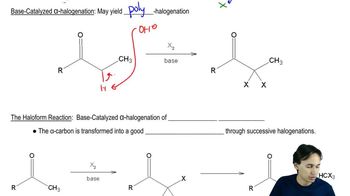
Base Catalyzed