Which is a better leaving group, HO⁻ or H2O? Explain your answer.
Ch. 12 - Substitution and Elimination: Reactions of Haloalkanes

Mullins1st EditionOrganic Chemistry: A Learner Centered ApproachISBN: 9780137566471Not the one you use?Change textbook
All textbooks
Mullins 1st Edition
Ch. 12 - Substitution and Elimination: Reactions of Haloalkanes
Problem 68
Mullins 1st Edition
Ch. 12 - Substitution and Elimination: Reactions of Haloalkanes
Problem 68Chapter 11, Problem 68
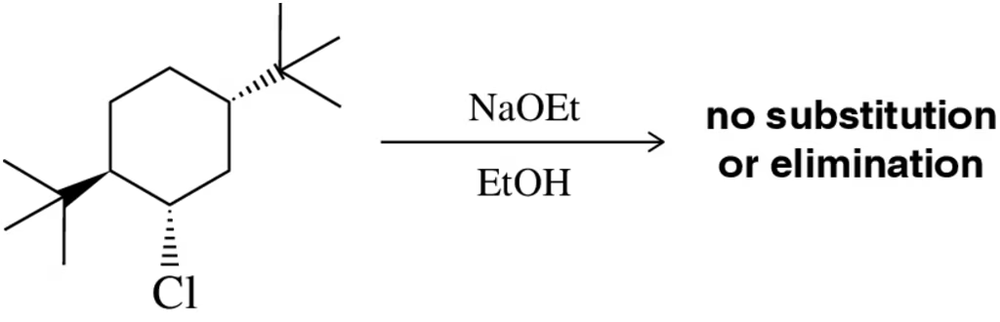
The following chlorocyclohexane undergoes neither Sₙ2 nor E2 under the conditions shown. Why?

Verified step by step guidance1
Analyze the structure of chlorocyclohexane: Chlorocyclohexane is a cyclohexane ring with a chlorine atom attached to one of the carbons. The chlorine atom is a good leaving group, but the reaction mechanism depends on the conditions provided.
Understand the Sₙ2 mechanism: The Sₙ2 mechanism requires a strong nucleophile and a substrate that is not sterically hindered. In the case of chlorocyclohexane, the cyclohexane ring creates steric hindrance, especially if the chlorine is in the equatorial position, making it difficult for the nucleophile to attack the carbon bearing the chlorine.
Understand the E2 mechanism: The E2 mechanism requires a strong base and an anti-periplanar arrangement of the β-hydrogen and the leaving group. In chlorocyclohexane, the anti-periplanar geometry may not be achievable due to the conformational constraints of the cyclohexane ring, especially if the chlorine is in the equatorial position.
Consider the reaction conditions: If the conditions provided do not include a strong nucleophile (for Sₙ2) or a strong base (for E2), neither mechanism will proceed. Additionally, steric hindrance and conformational constraints further inhibit these reactions.
Conclude why neither mechanism occurs: The combination of steric hindrance, conformational constraints, and potentially unsuitable reaction conditions prevents both the Sₙ2 and E2 mechanisms from occurring in this case.

Verified video answer for a similar problem:
This video solution was recommended by our tutors as helpful for the problem above.
Video duration:
8mWas this helpful?
Key Concepts
Here are the essential concepts you must grasp in order to answer the question correctly.
Sₙ2 Mechanism
The Sₙ2 mechanism is a bimolecular nucleophilic substitution reaction where a nucleophile attacks an electrophile, leading to the simultaneous displacement of a leaving group. This reaction typically occurs in primary or secondary substrates due to steric accessibility. In the case of chlorocyclohexane, steric hindrance from the cyclohexane ring can prevent effective nucleophilic attack, making Sₙ2 unlikely.
Recommended video:
Guided course
General Mechanism
E2 Mechanism
The E2 mechanism is a concerted elimination reaction where a base abstracts a proton while a leaving group departs, resulting in the formation of a double bond. This reaction is favored in secondary and tertiary substrates due to steric factors. In chlorocyclohexane, the ring structure may hinder the necessary anti-periplanar arrangement of the leaving group and the hydrogen, thus inhibiting E2 reactivity.
Recommended video:
Guided course
Drawing the E2 Mechanism.
Steric Hindrance
Steric hindrance refers to the prevention of chemical reactions due to the spatial arrangement of atoms within a molecule. In bulky molecules like chlorocyclohexane, the presence of large groups can obstruct the approach of nucleophiles or bases, making reactions like Sₙ2 and E2 less favorable. Understanding steric hindrance is crucial for predicting the reactivity of organic compounds.
Recommended video:
Guided course
Understanding steric effects.
Related Practice
Textbook Question
2
views
Textbook Question
When trans-4-bromocyclohexanol is treated with base, an intramolecular substitution reaction occurs to give a cyclic ether. This product does not form when cis-4-bromocyclohexanol is reacted under the same conditions. Explain these observations.
1
views
Textbook Question
Give a mechanism for the following substitution and elimination reactions.
(b)
1
views
Textbook Question
Give a mechanism for the following substitution and elimination reactions.
(c)
3
views
Textbook Question
The following substitution reaction, between a strong base and a 1° haloalkane, occurs in a single step via backside displacement. Yet it is not technically an SN2 reaction. Why?
1
views
Textbook Question
In addition to using mCPBA, epoxides can be synthesized from alkenes in the two-step process shown. Give a mechanism for each step of the process.
1
views