Ch. 12 - Substitution and Elimination: Reactions of Haloalkanes
Mullins - Organic Chemistry: A Learner Centered Approach 1st Edition
Mullins1st EditionOrganic Chemistry: A Learner Centered ApproachISBN: 9780137566471Not the one you use?Change textbook
Chapter 11, Problem 34b

Identify the bonds that break and form in the following elimination reactions.
(b) Chemical structure illustrating an elimination reaction with a chlorine atom and sodium ethoxide, producing an alkene and alcohol.

Verified step by step guidance
1
Step 1: Analyze the reaction type. This is an elimination reaction, specifically an E2 mechanism, as the base (NaOEt) is strong and the reaction occurs in a single step without intermediates.
Step 2: Identify the bonds that break. In the substrate, the bond between the carbon atom attached to the chlorine (C-Cl bond) breaks, and the bond between the β-hydrogen (hydrogen on the carbon adjacent to the carbon bonded to chlorine) and its carbon also breaks.
Step 3: Identify the bonds that form. A new π bond forms between the α-carbon (the carbon bonded to chlorine) and the β-carbon (the carbon adjacent to the α-carbon). Additionally, the base (NaOEt) abstracts the β-hydrogen, forming ethanol (EtOH).
Step 4: Understand the stereochemistry. The elimination reaction follows the anti-periplanar geometry, meaning the β-hydrogen and the leaving group (Cl) must be in opposite planes for the reaction to proceed efficiently.
Step 5: Summarize the process. The reaction involves breaking the C-Cl bond and the C-H bond on the β-carbon, forming a double bond between the α- and β-carbons, and producing ethanol as a byproduct.

Verified video answer for a similar problem:

This video solution was recommended by our tutors as helpful for the problem above.
Was this helpful?

Key Concepts

Here are the essential concepts you must grasp in order to answer the question correctly.

Elimination Reactions

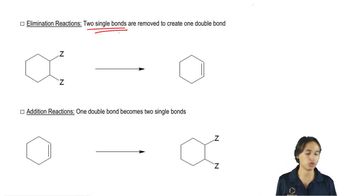
Elimination reactions involve the removal of atoms or groups from a molecule, resulting in the formation of a double bond. In this specific reaction, a halogen (chlorine) and a hydrogen atom are eliminated from adjacent carbon atoms, leading to the formation of an alkene. Understanding the mechanism of elimination is crucial for predicting the products formed.
Recommended video:
Guided course
00:40
Recognizing Elimination Reactions.

Bonds Breaking and Forming

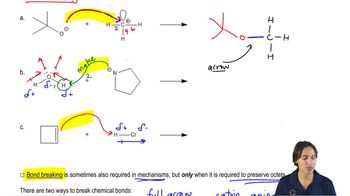
In the elimination reaction shown, a C-Cl bond breaks as the chlorine atom is removed, while a new C=C double bond forms between the adjacent carbon atoms. Additionally, a C-H bond is also broken to facilitate the formation of the double bond. Recognizing which bonds are involved is essential for understanding the reaction mechanism and the resulting products.
Recommended video:
Guided course
02:31
Identifying Bond Breaking

Base Catalysis

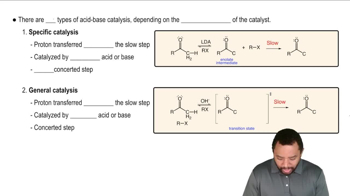
The reaction uses sodium ethoxide (NaOEt) as a strong base to facilitate the elimination process. The base abstracts a proton from the carbon adjacent to the carbon bearing the leaving group (Cl), promoting the formation of the double bond. Understanding the role of the base is important for grasping how elimination reactions proceed and the conditions required for them.
Recommended video:
2:50
Acid-Base Catalysis Concept 3