Ch. 12 - Substitution and Elimination: Reactions of Haloalkanes
Mullins - Organic Chemistry: A Learner Centered Approach 1st Edition
Mullins1st EditionOrganic Chemistry: A Learner Centered ApproachISBN: 9780137566471Not the one you use?Change textbook
Chapter 11, Problem 50a

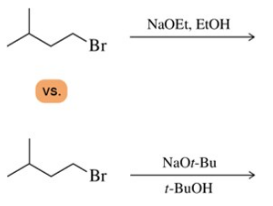
For which of the following reactions would you expect elimination to be more favored than substitution?
(a)

Verified step by step guidance
1
Step 1: Analyze the reaction conditions for both cases. In the first reaction, NaOEt (sodium ethoxide) in EtOH (ethanol) is used, which is a small, strong base. In the second reaction, NaOt-Bu (sodium tert-butoxide) in t-BuOH (tert-butanol) is used, which is a bulky, strong base.
Step 2: Understand the role of the base size in determining the reaction pathway. Small bases like NaOEt can easily approach the electrophilic carbon and favor substitution (S_N2 mechanism). Bulky bases like NaOt-Bu, due to steric hindrance, are less likely to approach the electrophilic carbon and instead favor elimination (E2 mechanism).
Step 3: Consider the structure of the alkyl halide. Both alkyl halides are secondary bromides, which can undergo both substitution and elimination. However, the steric hindrance around the electrophilic carbon plays a role in determining the favored pathway.
Step 4: Evaluate the solvent effects. Ethanol (EtOH) is a protic solvent that can stabilize the transition state for substitution reactions. Tert-butanol (t-BuOH), being bulky, does not stabilize substitution as effectively and further promotes elimination.
Step 5: Conclude that elimination is more favored in the second reaction (NaOt-Bu/t-BuOH) due to the bulky base and solvent, while substitution is more competitive in the first reaction (NaOEt/EtOH) due to the smaller base and solvent effects.

Verified video answer for a similar problem:

This video solution was recommended by our tutors as helpful for the problem above.
Video duration:
4m
Was this helpful?

Key Concepts

Here are the essential concepts you must grasp in order to answer the question correctly.

Elimination vs. Substitution Reactions

Elimination reactions involve the removal of a leaving group and a hydrogen atom, resulting in the formation of a double bond, while substitution reactions replace a leaving group with a nucleophile. The preference for one mechanism over the other depends on factors such as the structure of the substrate, the strength of the nucleophile/base, and the reaction conditions.
Recommended video:
Guided course
00:38
Intro to Substitution/Elimination Problems

Zaitsev's Rule

Zaitsev's Rule states that in elimination reactions, the more substituted alkene is typically the major product. This is due to the stability of more substituted alkenes, which are favored thermodynamically. Understanding this rule helps predict the outcome of elimination reactions, especially when considering steric hindrance and the nature of the base used.
Recommended video:
Guided course
01:18
Defining Zaitsev’s Rule

Sterics and Base Strength

The steric hindrance of the base and the substrate plays a crucial role in determining whether elimination or substitution will be favored. Bulky bases, like t-BuOK, tend to favor elimination due to their inability to effectively approach the substrate for substitution. Conversely, smaller bases can facilitate substitution reactions more readily, highlighting the importance of base choice in reaction pathways.
Recommended video:
Guided course
02:53
Understanding steric effects.