Ch. 12 - Substitution and Elimination: Reactions of Haloalkanes
Mullins - Organic Chemistry: A Learner Centered Approach 1st Edition
Mullins1st EditionOrganic Chemistry: A Learner Centered ApproachISBN: 9780137566471Not the one you use?Change textbook
Chapter 11, Problem 49c

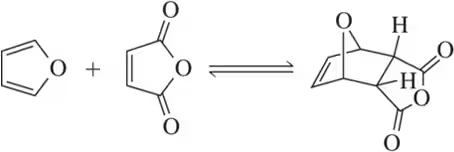
For the following reactions we have not seen yet, which side, if either, would be favored by increasing the temperature?
(c) Chemical reaction diagram showing reactants and products with arrows indicating equilibrium.

Verified step by step guidance
1
Step 1: Understand the principle of Le Chatelier's Principle, which states that a system at equilibrium will adjust to counteract changes imposed on it. Temperature changes affect equilibrium based on whether the reaction is exothermic or endothermic.
Step 2: Determine whether the reaction is exothermic (releases heat) or endothermic (absorbs heat). This information is crucial because increasing temperature favors the direction that absorbs heat (endothermic direction).
Step 3: Analyze the reaction equation provided. If the reaction is exothermic, increasing temperature will favor the reverse reaction (left side). If the reaction is endothermic, increasing temperature will favor the forward reaction (right side).
Step 4: Consider the equilibrium constant (K). For exothermic reactions, increasing temperature decreases K, favoring the reactants. For endothermic reactions, increasing temperature increases K, favoring the products.
Step 5: Apply the concept to the given reaction. If the reaction details (enthalpy change, ΔH) are provided, use them to determine the favored side. If ΔH > 0, the reaction is endothermic; if ΔH < 0, the reaction is exothermic.

Verified video answer for a similar problem:

This video solution was recommended by our tutors as helpful for the problem above.
Video duration:
2m
Was this helpful?

Key Concepts

Here are the essential concepts you must grasp in order to answer the question correctly.

Le Chatelier's Principle

Le Chatelier's Principle states that if a dynamic equilibrium is disturbed by changing the conditions, the system will adjust to counteract the change and restore a new equilibrium. This principle is crucial for predicting how changes in temperature, pressure, or concentration will affect the position of equilibrium in a chemical reaction.
Recommended video:
Guided course
04:12
The Electron Configuration

Endothermic and Exothermic Reactions

Reactions can be classified as endothermic or exothermic based on their heat exchange with the surroundings. Endothermic reactions absorb heat, while exothermic reactions release heat. Understanding whether a reaction is endothermic or exothermic is essential for predicting how temperature changes will influence the equilibrium position.
Recommended video:
Guided course
05:09
Heck Reaction

Equilibrium Constant (K)

The equilibrium constant (K) quantifies the ratio of the concentrations of products to reactants at equilibrium for a given reaction at a specific temperature. Changes in temperature can alter the value of K, thereby affecting the position of equilibrium. Knowing how K varies with temperature helps in determining which side of the reaction is favored under different thermal conditions.
Recommended video:
Guided course
02:19
The relationship between equilibrium constant and pKa.