

The fact that allylic halogenation results in formation of the most stable alkene suggests that it is under thermodynamic control. Thus, the second propagation step must be reversible. Suggest an arrow-pushing mechanism by which the less stable allylic halide might equilibrate to the more stable allylic halide.
Ch. 11 - Properties and Synthesis of Alkyl Halides: Radical Reactions

Mullins1st EditionOrganic Chemistry: A Learner Centered ApproachISBN: 9780137566471Not the one you use?Change textbook
All textbooks
Mullins 1st Edition
Ch. 11 - Properties and Synthesis of Alkyl Halides: Radical Reactions
Problem 34
Mullins 1st Edition
Ch. 11 - Properties and Synthesis of Alkyl Halides: Radical Reactions
Problem 34Chapter 10, Problem 34
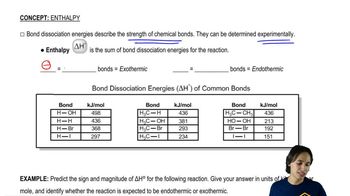
(a) Using bond-dissociation energies (Table 5.6), which of the indicated bonds should break most easily?
(b) How does that help you explain the results shown in Figure 11.40?

Verified step by step guidance1
Step 1: Understand the concept of bond-dissociation energy (BDE). Bond-dissociation energy is the energy required to break a specific bond in a molecule in the gas phase, forming two radicals. A lower BDE indicates that the bond is weaker and easier to break.
Step 2: Refer to Table 5.6 for the bond-dissociation energies of the bonds in question. Look up the BDE values for the H―Br bond and the Br―Br bond. For example, the BDE for H―Br is approximately 366 kJ/mol, while the BDE for Br―Br is approximately 193 kJ/mol.
Step 3: Compare the BDE values. Since the BDE for Br―Br is significantly lower than that for H―Br, the Br―Br bond is weaker and should break more easily.
Step 4: Relate this to the results shown in Figure 11.40. The figure likely demonstrates a reaction or process where the Br―Br bond breaks more readily than the H―Br bond, consistent with the lower BDE of Br―Br. This could explain why bromine radicals (Br•) are generated more easily from Br―Br dissociation.
Step 5: Conclude that the bond-dissociation energy values provide a quantitative explanation for the observed behavior in Figure 11.40, where the Br―Br bond breaks more easily than the H―Br bond due to its lower energy requirement.

Verified video answer for a similar problem:
This video solution was recommended by our tutors as helpful for the problem above.
Video duration:
6mWas this helpful?
Key Concepts
Here are the essential concepts you must grasp in order to answer the question correctly.
Bond-Dissociation Energy
Bond-dissociation energy (BDE) is the energy required to break a specific bond in a molecule, resulting in the formation of two radicals. It is a crucial concept in understanding the stability of chemical bonds; higher BDE values indicate stronger bonds that are less likely to break. In the context of the question, comparing the BDEs of H-Br and Br-Br bonds will help determine which bond is more easily broken.
Recommended video:
Guided course
How to calculate enthalpy using bond dissociation energies.
Radical Stability
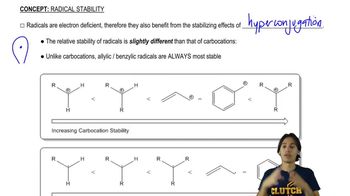
Radical stability refers to the relative stability of free radicals, which are species with unpaired electrons. The stability of a radical can be influenced by factors such as the presence of electron-donating groups or the degree of substitution. In the question, understanding the stability of the radicals formed from breaking H-Br and Br-Br bonds is essential for explaining the observed results in Figure 11.40.
Recommended video:
Guided course
The radical stability trend.
Reaction Mechanisms
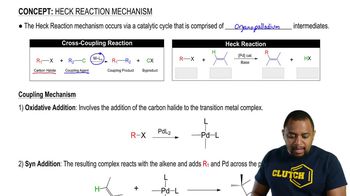
A reaction mechanism describes the step-by-step sequence of elementary reactions by which overall chemical change occurs. It provides insight into how bonds are broken and formed during a reaction. In this case, analyzing the mechanism involving the breaking of H-Br versus Br-Br bonds will clarify the differences in reactivity and help explain the results shown in Figure 11.40.
Recommended video:
Guided course
Heck Reaction Mechanism
Related Practice
Textbook Question
Textbook Question
Vitamin E, especially the B ring and the side chain, is a terpenoid derivative. Identify the isoprene units nature used to make it.
1
views
Textbook Question
Predict the products of the following allylic halogenation reactions.
(c)
1
views
Textbook Question
Predict the products of the following allylic halogenation reactions.
(d)
1
views
Textbook Question
The following polyunsaturated fat, which does not exist in nature, is oxidized at a rate similar to oleic acid (Table 11.14), despite having two cis-alkenes. Why?
2
views
Textbook Question
Name the following halogenated compounds according to the IUPAC rules of nomenclature.
(c)
2
views