
In Section 10.8.1, you learned that alkenes react more quickly with electrophiles than do the corresponding alkynes (kalkene/kalkyne > 1). Explain why there is a greater disparity in the alkene versus alkyne reactivity in the addition of HBr as compared to the addition of Br2 [The rate data are not real, but are meant to illustrate a real trend.]

Mullins 1st Edition
Ch. 10 - Alkynes: Electrophilic Addition and Redox Reactions
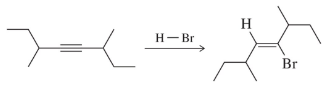
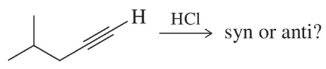
Problem 54The addition of H―X to alkynes has been shown to occur predominately via anti addition:

Two chemists disagreed on whether or not anti addition would happen on terminal alkynes as well. Suggest an experiment through which you could resolve this dispute.

Verified step by step guidance
Verified video answer for a similar problem:
Key Concepts
Alkynes and Their Reactivity
Anti Addition Mechanism
Experimental Design for Stereochemical Analysis
The synthesis of five-membered lactones (cyclic esters) has been accomplished using the electrophilic addition of I―Cl to an alkyne. Suggest a mechanism for this cyclization reaction. (Structure modification of Yao, T.; Larock, R.C. J. Org. Chem. 2005, 70, 1432–1437.)
Synthesize the following molecules beginning with only organic molecules containing three carbons or fewer.
(g)
A chemist attempted to do the following acetylide alkylation reaction but was unsuccessful in several attempts, producing only the original starting materials in each case. Explain why the reaction didn't work.
When alkynes are treated with water and bromine a bromoketone is produced. Provide a plausible arrow-pushing mechanism that accounts for the formation of this product.
Trans addition is heavily favored for the addition of Br₂ and Cl₂ to alkynes. With chlorination, however, more of the syn addition product is formed. Rationalize this fact in light of your answer to Assessments 10.50 and 10.51.