Ch. 10 - Alkynes: Electrophilic Addition and Redox Reactions
Mullins - Organic Chemistry: A Learner Centered Approach 1st Edition
Mullins1st EditionOrganic Chemistry: A Learner Centered ApproachISBN: 9780137566471Not the one you use?Change textbook
Chapter 9, Problem 49f

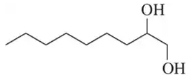
Synthesize the following molecules beginning with only organic molecules containing three carbons or fewer.
(f)

Verified step by step guidance
1
Step 1: Begin by identifying the target molecule, which is a 1,2-diol (two hydroxyl groups on adjacent carbons) with a total of 8 carbons in the chain. The synthesis must start with organic molecules containing three carbons or fewer.
Step 2: To construct the carbon chain, use successive alkylation reactions. Start with a three-carbon molecule such as propanal or propanone. Perform aldol condensation reactions to elongate the chain step by step, ensuring the correct connectivity of carbons.
Step 3: Once the desired carbon chain length is achieved (8 carbons), introduce the hydroxyl groups. Use epoxidation of an alkene intermediate followed by acid-catalyzed ring opening to form the 1,2-diol. For example, convert the terminal alkene to an epoxide using a peracid (e.g., mCPBA), then hydrolyze the epoxide under acidic conditions.
Step 4: Ensure stereochemistry is correct. If the target molecule requires specific stereochemistry, use reagents or conditions that favor the desired stereochemical outcome during the epoxide ring opening.
Step 5: Purify the final product using techniques such as distillation or recrystallization, and confirm the structure using spectroscopic methods like NMR and IR to ensure the synthesis was successful.

Verified video answer for a similar problem:

This video solution was recommended by our tutors as helpful for the problem above.
Was this helpful?

Key Concepts

Here are the essential concepts you must grasp in order to answer the question correctly.

Functional Groups

Functional groups are specific groups of atoms within molecules that are responsible for the characteristic chemical reactions of those molecules. In organic chemistry, common functional groups include alcohols (–OH), carboxylic acids (–COOH), and amines (–NH2). Understanding functional groups is essential for predicting the reactivity and properties of organic compounds.
Recommended video:
Guided course
02:36
Identifying Functional Groups

Synthesis of Organic Molecules

The synthesis of organic molecules involves constructing complex molecules from simpler ones through various chemical reactions. This process often requires knowledge of reaction mechanisms, reagents, and conditions. In this context, starting with molecules containing three carbons or fewer means utilizing basic building blocks like propane, propene, or alcohols to create larger, more complex structures.
Recommended video:
Guided course
02:17
Identifying organic molecules

Carbon Chain Length and Structure

The length and structure of carbon chains significantly influence the properties and reactivity of organic molecules. In the provided image, the molecule features a longer carbon chain with hydroxyl (–OH) groups, indicating it is likely a polyol. Understanding how to manipulate carbon chain length and branching is crucial for synthesizing desired organic compounds and predicting their behavior in reactions.
Recommended video:
Guided course
01:53
Learning Alkane Prefixes up to 12 Carbons in Length