Ch. 9 - Substitution and Elimination Reactions of Alkyl Halides
Bruice - Organic Chemistry 8th Edition
Bruice8th EditionOrganic ChemistryISBN: 9780135213711Not the one you use?Change textbook
Chapter 10, Problem 40

You were told in [SECTION 7.11] that is best to use a methyl halide or a primary alkyl halide for the reaction of an acetylide ion with an alkyl halide. Explain why this is so.

Verified step by step guidance
1
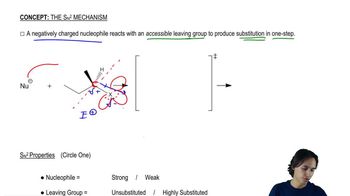
The reaction between an acetylide ion (a strong nucleophile) and an alkyl halide proceeds via an SN2 (bimolecular nucleophilic substitution) mechanism. In an SN2 reaction, the nucleophile attacks the electrophilic carbon of the alkyl halide from the opposite side of the leaving group, leading to a single-step, concerted reaction.
For an SN2 reaction to occur efficiently, steric hindrance around the electrophilic carbon must be minimal. Methyl halides and primary alkyl halides have less steric hindrance compared to secondary or tertiary alkyl halides, making them more reactive in SN2 reactions.
If a secondary or tertiary alkyl halide is used, the increased steric hindrance around the electrophilic carbon slows down or prevents the SN2 reaction. Additionally, tertiary alkyl halides are more likely to undergo elimination (E2) reactions instead of substitution.
The acetylide ion is a strong base as well as a strong nucleophile. When reacting with secondary or tertiary alkyl halides, the likelihood of elimination (E2) increases due to the steric hindrance, which makes substitution less favorable.
Therefore, using a methyl halide or a primary alkyl halide ensures that the reaction proceeds efficiently via the SN2 mechanism, avoiding complications such as steric hindrance or competing elimination reactions.

Verified video answer for a similar problem:

This video solution was recommended by our tutors as helpful for the problem above.
Video duration:
4m
Was this helpful?

Key Concepts

Here are the essential concepts you must grasp in order to answer the question correctly.

Acetylide Ion Reactivity

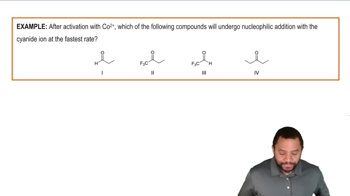
Acetylide ions are strong nucleophiles due to the high electron density on the carbon atom. This makes them highly reactive towards electrophiles, such as alkyl halides. Understanding the nucleophilicity of acetylide ions is crucial for predicting the outcome of reactions involving these species.
Recommended video:
2:18
Metal Ion Catalysis Example 1

SN2 Mechanism

The reaction between acetylide ions and alkyl halides typically follows an SN2 mechanism, where the nucleophile attacks the electrophile from the opposite side of the leaving group. This mechanism is favored with primary alkyl halides because they provide less steric hindrance, allowing for a more efficient reaction.
Recommended video:
Guided course
08:33
Drawing the SN2 Mechanism

Steric Hindrance

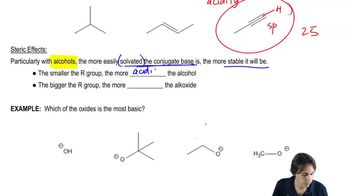
Steric hindrance refers to the crowding around a reactive site that can impede the approach of a nucleophile. Methyl and primary alkyl halides have minimal steric hindrance, making them more suitable for reactions with acetylide ions. In contrast, secondary and tertiary halides are less reactive due to increased steric hindrance, which can slow down or prevent the reaction.
Recommended video:
Guided course
02:53
Understanding steric effects.