Ch. 9 - Substitution and Elimination Reactions of Alkyl Halides
Bruice - Organic Chemistry 8th Edition
Bruice8th EditionOrganic ChemistryISBN: 9780135213711Not the one you use?Change textbook
Chapter 10, Problem 39c

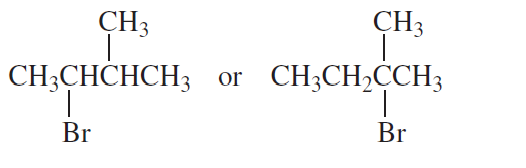
Which reacts faster in an SN1 reaction?
Structural formulas of two organic compounds with bromine, comparing their reactivity in a substitution reaction.

Verified step by step guidance
1
Step 1: Understand the SN1 reaction mechanism. SN1 reactions proceed via a two-step mechanism: (1) formation of a carbocation intermediate by the departure of the leaving group, and (2) nucleophilic attack on the carbocation. The rate-determining step is the formation of the carbocation, so the stability of the carbocation is a key factor in determining the reaction rate.
Step 2: Evaluate the structure of the reactants. Identify the type of carbon (primary, secondary, or tertiary) attached to the leaving group. Tertiary carbocations are more stable than secondary, which are more stable than primary, due to hyperconjugation and inductive effects.
Step 3: Consider the leaving group. A good leaving group facilitates the formation of the carbocation. Leaving groups such as halides (e.g., Cl⁻, Br⁻, I⁻) or sulfonates (e.g., tosylate) are commonly involved in SN1 reactions. Compare the leaving groups of the reactants to determine which one is better.
Step 4: Assess the solvent. SN1 reactions are favored in polar protic solvents (e.g., water, alcohols) because they stabilize the carbocation intermediate and the leaving group. Check if the reaction conditions include such solvents.
Step 5: Combine all factors. Based on the stability of the carbocation, the quality of the leaving group, and the solvent conditions, determine which reactant will react faster in the SN1 reaction. The reactant that forms the most stable carbocation and has the best leaving group will typically react faster.

Verified video answer for a similar problem:

This video solution was recommended by our tutors as helpful for the problem above.
Video duration:
2m
Was this helpful?

Key Concepts

Here are the essential concepts you must grasp in order to answer the question correctly.

SN1 Reaction Mechanism

The SN1 (Substitution Nucleophilic Unimolecular) reaction mechanism involves two main steps: the formation of a carbocation intermediate and the subsequent nucleophilic attack. The rate of an SN1 reaction depends primarily on the stability of the carbocation formed, as the first step is the rate-determining step. More stable carbocations, such as tertiary carbocations, react faster than less stable ones.
Recommended video:
Guided course
10:49
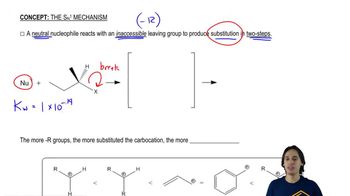
Drawing the SN1 Mechanism

Carbocation Stability

Carbocation stability is influenced by the degree of alkyl substitution and resonance. Tertiary carbocations are the most stable due to hyperconjugation and inductive effects from surrounding alkyl groups. In contrast, primary carbocations are the least stable, making them less likely to form in SN1 reactions. Understanding the stability of carbocations is crucial for predicting the reactivity in SN1 mechanisms.
Recommended video:
Guided course
05:58
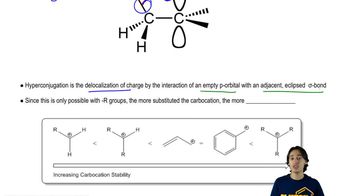
Determining Carbocation Stability

Nucleophilicity

Nucleophilicity refers to the ability of a nucleophile to donate an electron pair to an electrophile. In SN1 reactions, the nucleophile attacks the carbocation after its formation. While the strength of the nucleophile can influence the overall reaction rate, in SN1 reactions, the rate is primarily determined by the stability of the carbocation rather than the nucleophile's strength.
Recommended video:
Guided course
08:27
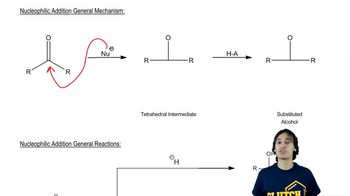
Nucleophilic Addition