Ch. 9 - Substitution and Elimination Reactions of Alkyl Halides
Bruice - Organic Chemistry 8th Edition
Bruice8th EditionOrganic ChemistryISBN: 9780135213711Not the one you use?Change textbook
Chapter 10, Problem 86c,d

Which species in each pair is more stable?
c.
d.

Verified step by step guidance
1
Step 1: Analyze the stability of the first pair of species. The stability of a carbanion is influenced by factors such as inductive effects, resonance stabilization, and hyperconjugation. In the first pair, compare the carbanion on CH₂CH₂CH=CH₂ versus CH₃CHCH=CH₂.
Step 2: For the first pair, consider the inductive effect of the alkyl groups. Alkyl groups are electron-donating, which destabilizes a carbanion. The CH₃ group in CH₃CHCH=CH₂ will donate electrons via induction, making the carbanion less stable compared to CH₂CH₂CH=CH₂, which has no such electron-donating group.
Step 3: Analyze the stability of the second pair of species. The stability of alkenes is influenced by the degree of substitution on the double bond. More substituted alkenes are generally more stable due to hyperconjugation and inductive effects.
Step 4: For the second pair, compare the substitution on the double bond. CH₃CHCH=CH₂ has a double bond with three substituents (two CH₃ groups and one CH₂ group), while CH₃CH₂C=CH₂ has a double bond with two substituents (one CH₃ group and one CH₂ group). The greater substitution in CH₃CHCH=CH₂ makes it more stable.
Step 5: Summarize the findings: In the first pair, CH₂CH₂CH=CH₂ is more stable due to less destabilization from inductive effects. In the second pair, CH₃CHCH=CH₂ is more stable due to higher substitution on the double bond.

Verified video answer for a similar problem:

This video solution was recommended by our tutors as helpful for the problem above.
Video duration:
3m
Was this helpful?

Key Concepts

Here are the essential concepts you must grasp in order to answer the question correctly.

Stability of Alkenes

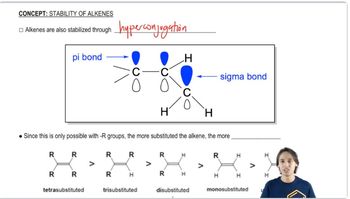
The stability of alkenes is influenced by the degree of substitution at the double bond. More substituted alkenes are generally more stable due to hyperconjugation and the inductive effect, which help to distribute electron density. In the given pairs, analyzing the substitution pattern around the double bond is crucial for determining which species is more stable.
Recommended video:
Guided course
04:28
Understanding trends of alkene stability.

Hyperconjugation

Hyperconjugation is a stabilizing interaction that occurs when the electrons in a sigma bond (usually C-H or C-C) interact with an adjacent empty or partially filled p-orbital or π-bond. This effect allows for the delocalization of electrons, which increases the stability of the molecule. In alkenes, more hyperconjugative interactions from adjacent alkyl groups lead to greater stability.
Recommended video:
Guided course
04:28
Understanding trends of alkene stability.

Inductive Effect

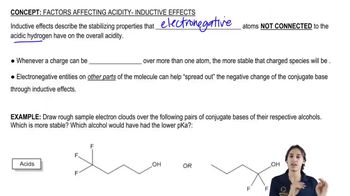
The inductive effect refers to the electron-withdrawing or electron-donating effects of substituents through sigma bonds. Electronegative atoms or groups can pull electron density away from the double bond, affecting its stability. In evaluating the stability of the given species, considering the nature and position of substituents relative to the double bond is essential for understanding their influence on stability.
Recommended video:
Guided course
01:47
Understanding the Inductive Effect.