
Ch. 9 - Substitution and Elimination Reactions of Alkyl Halides
Bruice - Organic Chemistry 8th Edition
Bruice8th EditionOrganic ChemistryISBN: 9780135213711Not the one you use?Change textbook
Chapter 10, Problem 87

A chemist wanted to synthesize the anesthetic 2-ethoxy-2-methylpropane. He used ethoxide ion and 2-chloro-2-methylpropane for his synthesis and ended up with no ether. What was the product of his synthesis? What reagents should he have used?

Verified step by step guidance
1
Step 1: Analyze the reaction setup. The chemist attempted to synthesize 2-ethoxy-2-methylpropane using ethoxide ion (\( \text{CH}_3\text{CH}_2\text{O}^- \)) and 2-chloro-2-methylpropane (\( \text{(CH}_3\text{)}_3\text{CCl} \)). This is a nucleophilic substitution reaction, but the structure of 2-chloro-2-methylpropane suggests steric hindrance around the carbon attached to the leaving group (Cl).
Step 2: Consider the reaction mechanism. Due to the steric hindrance in 2-chloro-2-methylpropane, the ethoxide ion is unlikely to perform an \( S_N2 \) substitution. Instead, the ethoxide ion, being a strong base, will favor an elimination reaction (\( E2 \)) to form an alkene. The product of this elimination reaction would be 2-methylpropene (\( \text{CH}_2=\text{C(CH}_3\text{)}_2 \)).
Step 3: Identify the issue with the chosen reagents. The chemist's choice of 2-chloro-2-methylpropane and ethoxide ion is not suitable for synthesizing 2-ethoxy-2-methylpropane because the steric hindrance prevents the desired \( S_N2 \) reaction, and the strong base promotes elimination instead.
Step 4: Propose the correct reagents. To synthesize 2-ethoxy-2-methylpropane, the chemist should use an \( S_N1 \) reaction mechanism. This requires a less sterically hindered nucleophile and a polar protic solvent to stabilize the carbocation intermediate. A better approach would be to use ethanol (\( \text{CH}_3\text{CH}_2\text{OH} \)) as the nucleophile and a polar protic solvent, such as water or ethanol itself, to facilitate the \( S_N1 \) reaction.
Step 5: Explain the revised reaction. In the \( S_N1 \) mechanism, 2-chloro-2-methylpropane will first form a stable tertiary carbocation (\( \text{(CH}_3\text{)}_3\text{C}^+ \)) after the chloride ion leaves. Ethanol will then act as the nucleophile, attacking the carbocation to form 2-ethoxy-2-methylpropane (\( \text{(CH}_3\text{)}_3\text{COCH}_2\text{CH}_3 \)).

Verified video answer for a similar problem:

This video solution was recommended by our tutors as helpful for the problem above.
Video duration:
7m
Was this helpful?

Key Concepts

Here are the essential concepts you must grasp in order to answer the question correctly.

Nucleophilic Substitution Reactions

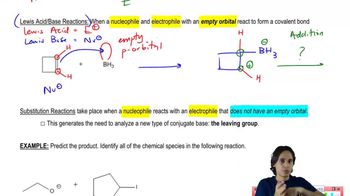
Nucleophilic substitution reactions involve the replacement of a leaving group in a molecule by a nucleophile. In this case, the ethoxide ion acts as a nucleophile, attacking the electrophilic carbon in 2-chloro-2-methylpropane. Understanding the mechanism of these reactions, including factors like steric hindrance and the nature of the leaving group, is crucial for predicting the outcome of the synthesis.
Recommended video:
Guided course
01:47
Nucleophiles and Electrophiles can react in Substitution Reactions.

Ethers and Their Synthesis

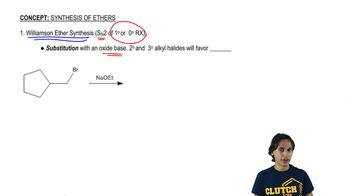
Ethers are organic compounds characterized by an oxygen atom bonded to two alkyl or aryl groups. The synthesis of ethers typically involves the reaction of an alcohol with an alkyl halide in the presence of a strong base, such as sodium ethoxide. Recognizing the conditions required for ether formation helps in identifying why the chemist did not obtain the desired product in this case.
Recommended video:
Guided course
03:50
The Mechanism of Williamson Ether Synthesis.

Reactivity of Alkyl Halides

The reactivity of alkyl halides is influenced by their structure, particularly the degree of substitution at the carbon atom bonded to the halogen. Tertiary alkyl halides, like 2-chloro-2-methylpropane, tend to undergo elimination reactions rather than substitution due to steric hindrance. This concept is essential for understanding why the chemist's attempt to synthesize the ether failed and what alternative reagents could facilitate the desired reaction.
Recommended video:
Guided course
01:52
How to name alkyl halides