Ch. 9 - Substitution and Elimination Reactions of Alkyl Halides
Bruice - Organic Chemistry 8th Edition
Bruice8th EditionOrganic ChemistryISBN: 9780135213711Not the one you use?Change textbook
Chapter 10, Problem 37

Which isomer reacts more rapidly in an E2 reaction: cis-1-bromo-4-tert-butylcyclohexane or trans-1-bromo-4-tert-butylcyclohexane? Explain your answer.

Verified step by step guidance
1
Understand the E2 reaction mechanism: E2 reactions are bimolecular elimination reactions where a base removes a proton from the β-carbon, and the leaving group departs simultaneously, forming a double bond.
Consider the stereochemistry of the cyclohexane ring: In cyclohexane, substituents can be in axial or equatorial positions. For an E2 reaction, the leaving group and the hydrogen being abstracted must be antiperiplanar, meaning they should be on opposite sides of the ring.
Analyze the cis isomer: In cis-1-bromo-4-tert-butylcyclohexane, the bromine and tert-butyl group are on the same side of the cyclohexane ring. This configuration may not allow the bromine to be antiperiplanar to a hydrogen on the adjacent carbon, making the E2 reaction less favorable.
Analyze the trans isomer: In trans-1-bromo-4-tert-butylcyclohexane, the bromine and tert-butyl group are on opposite sides of the cyclohexane ring. This configuration allows the bromine to be antiperiplanar to a hydrogen on the adjacent carbon, facilitating the E2 reaction.
Conclude which isomer reacts more rapidly: The trans isomer is more likely to have the correct antiperiplanar arrangement for the E2 reaction, making it react more rapidly compared to the cis isomer.

Verified video answer for a similar problem:

This video solution was recommended by our tutors as helpful for the problem above.
Video duration:
6m
Was this helpful?

Key Concepts

Here are the essential concepts you must grasp in order to answer the question correctly.

E2 Reaction Mechanism

The E2 (bimolecular elimination) reaction is a concerted process where a base abstracts a proton while a leaving group departs, resulting in the formation of a double bond. The reaction rate depends on the concentration of both the substrate and the base. In cyclohexane derivatives, the stereochemistry of substituents can significantly influence the accessibility of the hydrogen atoms that are eliminated.
Recommended video:
Guided course
09:36
Drawing the E2 Mechanism.

Stereochemistry and Chair Conformation

Cyclohexane can adopt different chair conformations, which affect the spatial arrangement of substituents. In the case of cis and trans isomers, the positioning of bulky groups like tert-butyl can hinder or facilitate the approach of the base during the E2 reaction. The more accessible the hydrogen atoms are for elimination, the faster the reaction will proceed.
Recommended video:
1:38
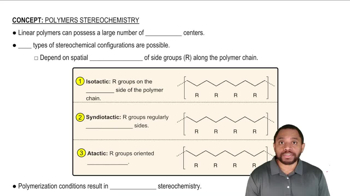
Polymer Stereochemistry Concept 1

Steric Hindrance

Steric hindrance refers to the repulsion between bulky groups that can impede reactions. In the context of the isomers in question, the bulky tert-butyl group in trans-1-bromo-4-tert-butylcyclohexane is positioned equatorially, allowing for better access to axial hydrogens for elimination. In contrast, the cis isomer may have more steric strain, leading to slower reaction rates.
Recommended video:
Guided course
02:53
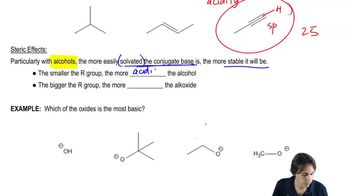
Understanding steric effects.