Ch. 9 - Substitution and Elimination Reactions of Alkyl Halides
Bruice - Organic Chemistry 8th Edition
Bruice8th EditionOrganic ChemistryISBN: 9780135213711Not the one you use?Change textbook
Chapter 10, Problem 38a

Draw the substitution and elimination products for the following reactions, showing the configuration of each product:
a. trans-1-chloro-2-methylcyclohexane + CH3O

Verified step by step guidance
1
Analyze the structure of the starting material, trans-1-chloro-2-methylcyclohexane. The chlorine atom is on one carbon of the cyclohexane ring, and the methyl group is on the adjacent carbon. Since the molecule is trans, the chlorine and methyl groups are on opposite sides of the ring (one axial and one equatorial).
Determine the type of reaction mechanism that can occur with CH3O⁻ (methoxide ion). CH3O⁻ is a strong base and a strong nucleophile, so both substitution (S_N2) and elimination (E2) reactions are possible. The reaction pathway depends on steric and electronic factors.
For the substitution (S_N2) pathway: The methoxide ion will attack the carbon bonded to the chlorine atom (the leaving group). Since S_N2 reactions proceed via a backside attack, the stereochemistry of the product will invert at the carbon where substitution occurs. Draw the product with the methoxy group replacing the chlorine, ensuring the stereochemistry is inverted.
For the elimination (E2) pathway: The methoxide ion will abstract a β-hydrogen (a hydrogen on a carbon adjacent to the carbon bearing the chlorine). In this case, the β-hydrogen must be anti-periplanar to the chlorine atom for the elimination to occur. Identify the anti-periplanar β-hydrogen, and draw the resulting alkene product. Ensure the double bond is formed between the carbon bearing the chlorine and the β-carbon, and show the correct stereochemistry of the alkene.
Summarize the products: For substitution, the product is the inverted stereochemical product with the methoxy group. For elimination, the product is the alkene with the correct stereochemistry based on the anti-periplanar geometry. Ensure both products are clearly drawn with their configurations labeled.

Verified video answer for a similar problem:

This video solution was recommended by our tutors as helpful for the problem above.
Video duration:
4m
Was this helpful?

Key Concepts

Here are the essential concepts you must grasp in order to answer the question correctly.

Substitution Reactions

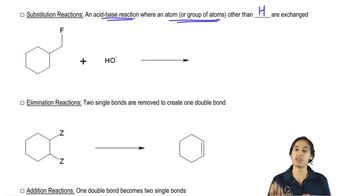
Substitution reactions involve the replacement of one atom or group in a molecule with another atom or group. In organic chemistry, nucleophilic substitution is common, where a nucleophile attacks an electrophilic carbon, leading to the formation of a new bond while the leaving group departs. Understanding the mechanism (SN1 or SN2) is crucial, as it influences the stereochemistry and regioselectivity of the products.
Recommended video:
Guided course
01:34
Recognizing Substitution Reactions.

Elimination Reactions

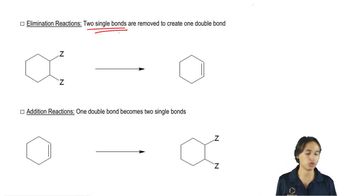
Elimination reactions involve the removal of a small molecule (often water or a halide) from a larger molecule, resulting in the formation of a double bond. In organic chemistry, common types include E1 and E2 mechanisms. The choice between substitution and elimination often depends on the structure of the substrate and the conditions of the reaction, such as the strength of the base used.
Recommended video:
Guided course
00:40
Recognizing Elimination Reactions.

Stereochemistry

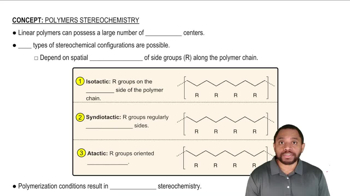
Stereochemistry refers to the spatial arrangement of atoms in molecules and how this affects their chemical behavior. In reactions involving chiral centers, the configuration (R/S) of products is critical, as it can influence the reactivity and properties of the compounds formed. Understanding stereochemistry is essential for predicting the outcomes of substitution and elimination reactions, especially in cyclic compounds like cyclohexane.
Recommended video:
1:38
Polymer Stereochemistry Concept 1