Ch. 9 - Substitution and Elimination Reactions of Alkyl Halides
Bruice - Organic Chemistry 8th Edition
Bruice8th EditionOrganic ChemistryISBN: 9780135213711Not the one you use?Change textbook
Chapter 10, Problem 73c

Starting with cyclohexene, how can the following compounds be prepared?
c. dicyclohexyl ether

Verified step by step guidance
1
Step 1: Begin with cyclohexene as the starting material. Cyclohexene is an alkene, and its double bond can be used for functionalization reactions.
Step 2: Perform an epoxidation reaction on cyclohexene to form cyclohexene oxide. This can be achieved using a peracid such as m-chloroperbenzoic acid (mCPBA). The reaction introduces an oxygen atom across the double bond, forming an epoxide.
Step 3: Open the epoxide ring by reacting cyclohexene oxide with cyclohexanol under acidic or basic conditions. This step forms dicyclohexyl ether through a nucleophilic attack of cyclohexanol on the epoxide ring.
Step 4: Ensure the reaction conditions are optimized to favor ether formation. For example, using an acid catalyst like sulfuric acid or a base like sodium hydroxide can help drive the reaction forward.
Step 5: Purify the product, dicyclohexyl ether, using techniques such as distillation or recrystallization to remove any unreacted starting materials or by-products.

Verified video answer for a similar problem:

This video solution was recommended by our tutors as helpful for the problem above.
Video duration:
5m
Was this helpful?

Key Concepts

Here are the essential concepts you must grasp in order to answer the question correctly.

Cyclohexene Reactivity

Cyclohexene is an alkene, which means it contains a carbon-carbon double bond. This double bond is reactive and can undergo various reactions, such as electrophilic addition, which can lead to the formation of different functional groups. Understanding the reactivity of cyclohexene is crucial for planning synthetic pathways to prepare compounds like dicyclohexyl ether.
Recommended video:
Guided course
01:17
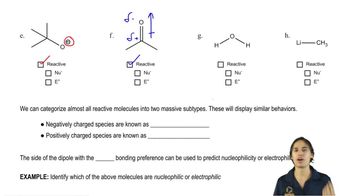
Reactivity of Molecules

Ether Formation

Ethers are organic compounds characterized by an oxygen atom connected to two alkyl or aryl groups. The formation of ethers can occur through several methods, including the reaction of alcohols with alkyl halides or through the dehydration of alcohols. In the context of synthesizing dicyclohexyl ether, knowing how to effectively form ethers from alcohols is essential.
Recommended video:
Guided course
04:22
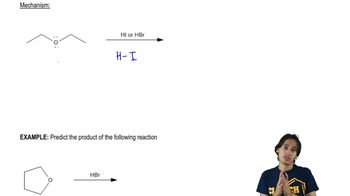
How to predict the products of Ether Cleavage.

Nucleophilic Substitution Reactions

Nucleophilic substitution reactions involve the replacement of a leaving group by a nucleophile. In the synthesis of dicyclohexyl ether, a nucleophile (such as an alkoxide ion) can attack an electrophilic carbon in a suitable substrate, leading to ether formation. Understanding the mechanisms and conditions for these reactions is vital for successful synthesis.
Recommended video:
Guided course
01:47
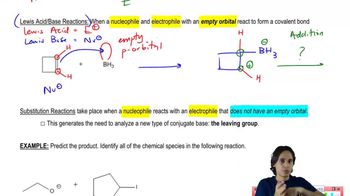
Nucleophiles and Electrophiles can react in Substitution Reactions.