Ch. 9 - Substitution and Elimination Reactions of Alkyl Halides
Bruice - Organic Chemistry 8th Edition
Bruice8th EditionOrganic ChemistryISBN: 9780135213711Not the one you use?Change textbook
Chapter 10, Problem 73b

Starting with cyclohexene, how can the following compounds be prepared?
b. cyclohexylmethylamine

Verified step by step guidance
1
Step 1: Begin with cyclohexene as the starting material. Cyclohexene is an alkene, and its double bond can be used for functionalization.
Step 2: Perform hydroboration-oxidation on cyclohexene to convert the double bond into an alcohol group. Use BH₃ (borane) followed by H₂O₂ (hydrogen peroxide) and NaOH (sodium hydroxide) to yield cyclohexanol.
Step 3: Convert cyclohexanol into cyclohexylmethyl bromide. This can be achieved by reacting cyclohexanol with PBr₃ (phosphorus tribromide), which replaces the hydroxyl group with a bromine atom.
Step 4: Perform a nucleophilic substitution reaction to replace the bromine atom with an amine group. React cyclohexylmethyl bromide with excess ammonia (NH₃) to yield cyclohexylmethylamine.
Step 5: Purify the product using standard organic chemistry techniques such as distillation or recrystallization to isolate cyclohexylmethylamine.

Verified video answer for a similar problem:

This video solution was recommended by our tutors as helpful for the problem above.
Video duration:
4m
Was this helpful?

Key Concepts

Here are the essential concepts you must grasp in order to answer the question correctly.

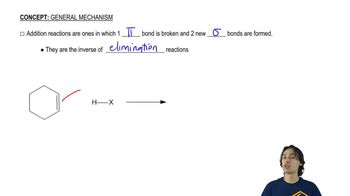
Electrophilic Addition Reactions

Electrophilic addition reactions are fundamental in organic chemistry, particularly for alkenes like cyclohexene. In these reactions, an electrophile reacts with a nucleophile, resulting in the addition of atoms or groups across the double bond. This process is crucial for converting cyclohexene into more complex structures, such as amines, by introducing functional groups.
Recommended video:
Guided course
05:39
Features of Addition Mechanisms.

Reduction of Carbonyl Compounds

Reduction is a key reaction in organic synthesis, where carbonyl compounds (like ketones or aldehydes) are converted into alcohols or amines. In the context of preparing cyclohexylmethylamine, a carbonyl compound derived from cyclohexene can be reduced using reducing agents such as lithium aluminum hydride (LiAlH4) or sodium borohydride (NaBH4) to yield the desired amine.
Recommended video:
Guided course
01:40
Defining meso compounds.

Amine Synthesis

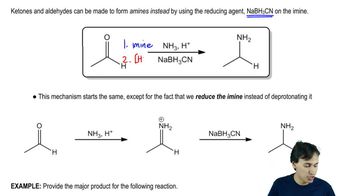
Amines are organic compounds derived from ammonia by replacing one or more hydrogen atoms with alkyl or aryl groups. The synthesis of cyclohexylmethylamine involves the introduction of an amine functional group to the cyclohexyl structure. This can be achieved through various methods, including reductive amination, where an amine reacts with a carbonyl compound, facilitating the formation of the amine product.
Recommended video:
Guided course
07:12
Reductive Amination