Ch. 9 - Substitution and Elimination Reactions of Alkyl Halides
Bruice - Organic Chemistry 8th Edition
Bruice8th EditionOrganic ChemistryISBN: 9780135213711Not the one you use?Change textbook
Chapter 10, Problem 103a,b

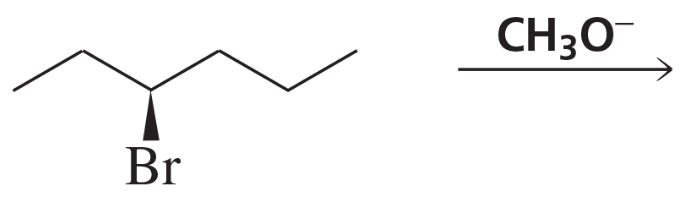
Draw the substitution and elimination products.
a.
b.

Verified step by step guidance
1
Step 1: Analyze the reactants and conditions. The substrate in both cases is a brominated alkane, and the reagent is methoxide ion (CH₃O⁻), which is a strong base and a good nucleophile. This suggests that both substitution (S_N2) and elimination (E2) reactions are possible.
Step 2: For substitution (S_N2), the methoxide ion will attack the carbon bonded to bromine directly, displacing the bromine atom. This reaction occurs in a single step and is favored for primary alkyl halides (as in part a). The product will be an ether (CH₃O attached to the carbon).
Step 3: For elimination (E2), the methoxide ion will act as a base and abstract a proton from a β-carbon (a carbon adjacent to the carbon bonded to bromine). This leads to the formation of a double bond between the α-carbon (the carbon bonded to bromine) and the β-carbon, with bromine leaving as a leaving group. The product will be an alkene.
Step 4: In part a, the substrate is a primary alkyl halide, so substitution (S_N2) is likely to be the major pathway, but elimination (E2) can also occur under these conditions. The substitution product will be CH₃OCH₂CH₂CH₂CH₃, and the elimination product will be CH₂=CHCH₂CH₃.
Step 5: In part b, the substrate is a secondary alkyl halide, which makes elimination (E2) more favorable due to steric hindrance around the electrophilic carbon. The elimination product will be the more substituted alkene (Zaitsev product), CH₃CH=CHCH₂CH₃, while the substitution product will be CH₃OCH(CH₃)CH₂CH₃.

Verified video answer for a similar problem:

This video solution was recommended by our tutors as helpful for the problem above.
Video duration:
1m
Was this helpful?

Key Concepts

Here are the essential concepts you must grasp in order to answer the question correctly.

Nucleophilic Substitution

Nucleophilic substitution is a fundamental reaction in organic chemistry where a nucleophile replaces a leaving group in a molecule. This process can occur via two main mechanisms: SN1, which involves a two-step process with a carbocation intermediate, and SN2, which is a one-step process where the nucleophile attacks the substrate simultaneously as the leaving group departs. Understanding the conditions that favor each mechanism is crucial for predicting the products of substitution reactions.
Recommended video:
Guided course
01:47
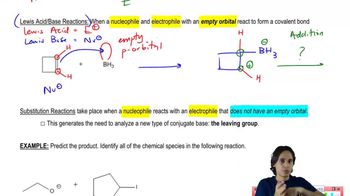
Nucleophiles and Electrophiles can react in Substitution Reactions.

Elimination Reactions

Elimination reactions involve the removal of a small molecule, typically water or hydrogen halide, from a larger molecule, resulting in the formation of a double bond. The two primary types are E1, which is a two-step process involving a carbocation intermediate, and E2, which is a concerted mechanism where the base abstracts a proton while the leaving group departs. Recognizing the factors that influence elimination, such as substrate structure and the strength of the base, is essential for determining the products.
Recommended video:
Guided course
00:40
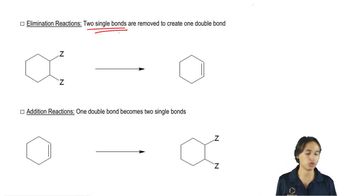
Recognizing Elimination Reactions.

Regioselectivity and Stereochemistry

Regioselectivity refers to the preference of a chemical reaction to yield one structural isomer over others when multiple possibilities exist. In substitution and elimination reactions, the regioselectivity can be influenced by the stability of intermediates and the nature of the nucleophile or base. Stereochemistry, on the other hand, deals with the spatial arrangement of atoms in molecules, which is crucial in determining the configuration of products, especially in reactions involving chiral centers.
Recommended video:
1:38
Polymer Stereochemistry Concept 1