Ch. 8 - Delocalized Electrons: Their Effect on Stability, pKa, and the Products of a Reaction • Aromaticity and Electronic Effects: An Introduction to the Reactions of Benzene
Bruice - Organic Chemistry 8th Edition
Bruice8th EditionOrganic ChemistryISBN: 9780135213711Not the one you use?Change textbook
Chapter 9, Problem 59

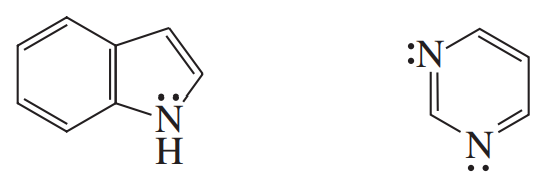
Which of the following compounds could be protonated without destroying its aromaticity?
Chemical structures of aromatic heterocycles, highlighting potential protonation sites without losing aromaticity.

Verified step by step guidance
1
Step 1: Recall the criteria for aromaticity. A compound is aromatic if it satisfies Huckel's rule, which states that it must have a planar, cyclic structure with a conjugated π-electron system containing (4n + 2) π-electrons, where n is an integer.
Step 2: Analyze pyrrole. Pyrrole is a five-membered ring with a nitrogen atom. The nitrogen contributes two electrons from its lone pair to the π-system, making the total π-electron count 6 (4n + 2, where n = 1). Protonating the nitrogen would remove its lone pair from the π-system, disrupting aromaticity.
Step 3: Analyze pyridine. Pyridine is a six-membered ring with a nitrogen atom. The nitrogen's lone pair is not part of the π-system; it resides in an sp2 orbital perpendicular to the ring. Protonating the nitrogen does not affect the π-electron count, which remains 6 (4n + 2, where n = 1), preserving aromaticity.
Step 4: Compare the two compounds. Protonation of pyrrole destroys its aromaticity because the lone pair on nitrogen is essential for the π-system. Protonation of pyridine does not affect its aromaticity because the lone pair on nitrogen is not part of the π-system.
Step 5: Conclude that pyridine can be protonated without destroying its aromaticity, while pyrrole cannot.

Verified video answer for a similar problem:

This video solution was recommended by our tutors as helpful for the problem above.
Video duration:
7m
Was this helpful?

Key Concepts

Here are the essential concepts you must grasp in order to answer the question correctly.

Aromaticity

Aromaticity is a property of cyclic compounds that exhibit enhanced stability due to the delocalization of π electrons across the ring structure. For a compound to be aromatic, it must follow Hückel's rule, which states that it should have (4n + 2) π electrons, where n is a non-negative integer. This delocalization allows for resonance, contributing to the compound's stability and unique reactivity.
Recommended video:
Guided course
08:19
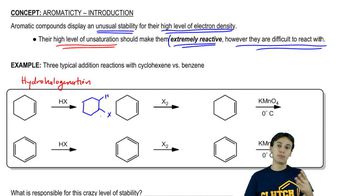
Intro to Aromaticity

Protonation

Protonation is the addition of a proton (H⁺) to a molecule, which can alter its chemical properties and reactivity. In the context of aromatic compounds, protonation can disrupt aromaticity if it occurs at a position that affects the delocalized π system. Understanding where protonation can occur without disrupting aromaticity is crucial for predicting the behavior of these compounds in chemical reactions.
Recommended video:
Guided course
03:
Proton Splitting

Comparison of Pyrrole and Pyridine

Pyrrole and pyridine are both nitrogen-containing heterocycles, but they differ significantly in their aromaticity and reactivity. Pyrrole, with a nitrogen atom contributing to the π system, is less stable and can be easily protonated, which disrupts its aromaticity. In contrast, pyridine, where nitrogen is part of the ring but does not contribute to the π system, can be protonated at the nitrogen without losing its aromatic character, making it a more stable base.
Recommended video:
1:18
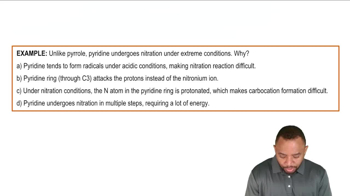
EAS Reactions of Pyridine Example 1