
Ch. 8 - Delocalized Electrons: Their Effect on Stability, pKa, and the Products of a Reaction • Aromaticity and Electronic Effects: An Introduction to the Reactions of Benzene
Bruice - Organic Chemistry 8th Edition
Bruice8th EditionOrganic ChemistryISBN: 9780135213711Not the one you use?Change textbook
Chapter 9, Problem 18c,d

Which member of each pair is the stronger base?
c. phenolate ion or ethoxide ion
d. phenolate ion or acetate ion

Verified step by step guidance
1
Step 1: Understand the concept of basicity. A stronger base is better at accepting protons (H⁺). The strength of a base is influenced by factors such as resonance stabilization, electronegativity, and inductive effects.
Step 2: Analyze the phenolate ion (A-i) and ethoxide ion (A-ii). The phenolate ion has resonance stabilization due to the aromatic ring, which delocalizes the negative charge on the oxygen atom. In contrast, the ethoxide ion does not have resonance stabilization, so its negative charge is localized on the oxygen atom, making it a stronger base.
Step 3: Compare the phenolate ion (B-i) and acetate ion (B-ii). The acetate ion has resonance stabilization between the two oxygen atoms, which delocalizes the negative charge and reduces its ability to accept protons. The phenolate ion also has resonance stabilization, but the aromatic ring is less effective at delocalizing the charge compared to the acetate ion. Thus, the phenolate ion is the stronger base.
Step 4: Consider the role of resonance in stabilizing the conjugate base. Resonance stabilization decreases basicity because the negative charge is spread out, making the base less reactive toward protons.
Step 5: Summarize the findings: Ethoxide ion is the stronger base compared to phenolate ion in part (c), and phenolate ion is the stronger base compared to acetate ion in part (d).

Verified video answer for a similar problem:

This video solution was recommended by our tutors as helpful for the problem above.
Video duration:
6m
Was this helpful?

Key Concepts

Here are the essential concepts you must grasp in order to answer the question correctly.

Acidity and Basicity

Acidity and basicity are fundamental concepts in organic chemistry that describe the tendency of a compound to donate or accept protons (H+ ions). A stronger base is a species that can more readily accept protons, while a stronger acid can more easily donate protons. The strength of acids and bases is often compared using their conjugate pairs, where the stability of the conjugate base influences the strength of the acid.
Recommended video:
Guided course
06:21
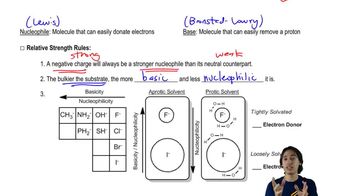
Understanding the difference between basicity and nucleophilicity.

Resonance Stabilization

Resonance stabilization occurs when a molecule can be represented by multiple valid Lewis structures, leading to a delocalization of electrons. This delocalization can stabilize negative charges, making certain anions, like phenolate, less basic than their counterparts. In the case of phenolate, the negative charge is delocalized over the aromatic ring, reducing its ability to accept protons compared to a less stabilized base like ethoxide.
Recommended video:
Guided course
03:43
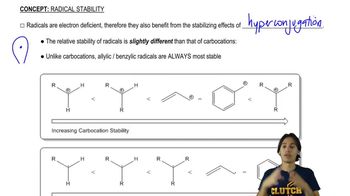
The radical stability trend.

Inductive Effect

The inductive effect refers to the electron-withdrawing or electron-donating effects of substituents in a molecule, which can influence acidity and basicity. Electron-withdrawing groups can stabilize negative charges, making the corresponding conjugate base less basic. In the comparison of acetate and phenolate ions, the presence of the carbonyl group in acetate exerts an inductive effect that can affect its basicity relative to phenolate.
Recommended video:
Guided course
01:47
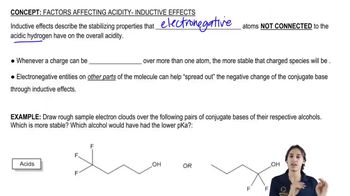
Understanding the Inductive Effect.