
Ch. 8 - Delocalized Electrons: Their Effect on Stability, pKa, and the Products of a Reaction • Aromaticity and Electronic Effects: An Introduction to the Reactions of Benzene
Bruice - Organic Chemistry 8th Edition
Bruice8th EditionOrganic ChemistryISBN: 9780135213711Not the one you use?Change textbook
Chapter 9, Problem 15a,b,c

Answer the following questions for the MOs of 1,3-butadiene:
a. Which are π\(\pi\) bonding MOs, and which are π\(\pi\)* antibonding MOs?
b. Which MOs are symmetric, and which are antisymmetric?
c. Which MO is the HOMO and which is the LUMO in the ground state?

Verified step by step guidance
1
Step 1: Understand the molecular orbital (MO) theory for conjugated systems like 1,3-butadiene. In 1,3-butadiene, there are four p orbitals (one on each carbon atom in the conjugated system) that combine to form four molecular orbitals: two bonding (π) MOs and two antibonding (π*) MOs. The bonding MOs are lower in energy, while the antibonding MOs are higher in energy.
Step 2: Assign symmetry properties to the MOs. Symmetry in MOs is determined by how the wavefunctions behave under reflection through the molecular plane or inversion through the center. Symmetric MOs remain unchanged under these operations, while antisymmetric MOs change sign. For 1,3-butadiene, the lowest energy MO (π1) is symmetric, the second MO (π2) is antisymmetric, the third MO (π3*) is symmetric, and the highest energy MO (π4*) is antisymmetric.
Step 3: Identify the HOMO (highest occupied molecular orbital) and LUMO (lowest unoccupied molecular orbital) in the ground state. In the ground state of 1,3-butadiene, the two bonding MOs (π1 and π2) are fully occupied, while the antibonding MOs (π3* and π4*) are unoccupied. Therefore, the HOMO is π2, and the LUMO is π3*.
Step 4: Classify the MOs as bonding or antibonding. Bonding MOs (π1 and π2) have constructive overlap of p orbitals, leading to electron density between the nuclei and lower energy. Antibonding MOs (π3* and π4*) have destructive overlap, leading to nodes between nuclei and higher energy.
Step 5: Summarize the findings. The bonding MOs are π1 and π2, and the antibonding MOs are π3* and π4*. Symmetric MOs are π1 and π3*, while antisymmetric MOs are π2 and π4*. The HOMO is π2, and the LUMO is π3* in the ground state.

Verified video answer for a similar problem:

This video solution was recommended by our tutors as helpful for the problem above.
Video duration:
5m
Was this helpful?

Key Concepts

Here are the essential concepts you must grasp in order to answer the question correctly.

Molecular Orbitals (MOs)

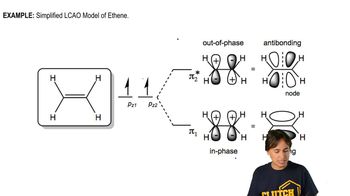
Molecular orbitals are formed by the linear combination of atomic orbitals (LCAO) when atoms bond together. In the case of 1,3-butadiene, the p orbitals of the carbon atoms combine to create bonding (p) and antibonding (p*) molecular orbitals. Understanding the energy levels and characteristics of these MOs is crucial for analyzing the electronic structure of the molecule.
Recommended video:
Guided course
08:41
Review of Molecular Orbitals

Symmetry in Molecular Orbitals

Symmetry in molecular orbitals refers to the spatial distribution of the electron density in relation to the molecular axis. Symmetric MOs remain unchanged when the molecule is reflected, while antisymmetric MOs change sign. This concept is important for determining the allowed transitions and the overall behavior of the molecule in various chemical reactions.
Recommended video:
Guided course
08:41
Review of Molecular Orbitals

HOMO and LUMO

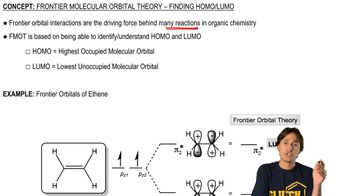
The Highest Occupied Molecular Orbital (HOMO) and the Lowest Unoccupied Molecular Orbital (LUMO) are critical in understanding a molecule's reactivity and electronic properties. The HOMO is the highest energy orbital that contains electrons, while the LUMO is the lowest energy orbital that is empty. The energy gap between these two orbitals influences the molecule's ability to absorb light and participate in chemical reactions.
Recommended video:
Guided course
02:35
HOMO vs. LUMO