Ch. 8 - Delocalized Electrons: Their Effect on Stability, pKa, and the Products of a Reaction • Aromaticity and Electronic Effects: An Introduction to the Reactions of Benzene
Bruice - Organic Chemistry 8th Edition
Bruice8th EditionOrganic ChemistryISBN: 9780135213711Not the one you use?Change textbook
Chapter 9, Problem 69d

Which ion in each of the following pairs is more stable?
d. Comparison of two ions with the question, "Which ion in each pair is more stable?"

Verified step by step guidance
1
Step 1: Analyze the chemical structures provided in the image. The two ions appear to be cyclopropyl carbocations, with one structure having conjugation with a double bond and the other lacking conjugation.
Step 2: Recall the concept of resonance stabilization. Conjugation between a carbocation and a double bond allows for delocalization of electrons, which stabilizes the ion.
Step 3: Evaluate the stability of the carbocations. The ion with the double bond adjacent to the carbocation can participate in resonance, spreading the positive charge over multiple atoms. This makes it more stable.
Step 4: Consider the lack of resonance in the second structure. The carbocation in the second structure is isolated and cannot delocalize its positive charge, making it less stable.
Step 5: Conclude that the ion with conjugation (the structure on the left) is more stable due to resonance stabilization, while the ion on the right is less stable due to the absence of resonance.

Verified video answer for a similar problem:

This video solution was recommended by our tutors as helpful for the problem above.
Video duration:
2m
Was this helpful?

Key Concepts

Here are the essential concepts you must grasp in order to answer the question correctly.

Aromatic Stability

Aromatic compounds are particularly stable due to their cyclic structure and the delocalization of π electrons across the ring. This stability arises from fulfilling Huckel's rule, which states that a compound must have 4n + 2 π electrons (where n is a non-negative integer) to be considered aromatic. The resonance energy associated with this delocalization contributes significantly to the overall stability of the molecule.
Recommended video:
Guided course
08:19
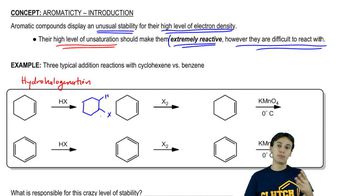
Intro to Aromaticity

Resonance Structures

Resonance structures are different ways of drawing a molecule that illustrate the delocalization of electrons. In the context of aromatic compounds, these structures help to visualize how electrons are shared across multiple bonds, leading to increased stability. The actual structure of the molecule is a hybrid of these resonance forms, which stabilizes the compound by lowering its energy.
Recommended video:
Guided course
03:04
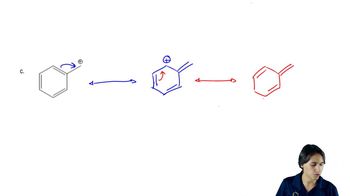
Drawing Resonance Structures

Inductive and Mesomeric Effects

Inductive effects refer to the electron-withdrawing or donating effects of substituents through sigma bonds, while mesomeric effects involve the delocalization of electrons through pi bonds. Both effects influence the stability of ions and molecules. In the comparison of the two structures in the question, the presence of electron-donating or withdrawing groups can significantly affect the stability of the resulting ions, making it essential to consider these effects when determining which ion is more stable.
Recommended video:
Guided course
01:47
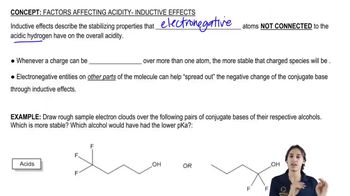
Understanding the Inductive Effect.