Ch. 8 - Delocalized Electrons: Their Effect on Stability, pKa, and the Products of a Reaction • Aromaticity and Electronic Effects: An Introduction to the Reactions of Benzene
Bruice - Organic Chemistry 8th Edition
Bruice8th EditionOrganic ChemistryISBN: 9780135213711Not the one you use?Change textbook
Chapter 9, Problem 69c

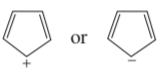
Which ion in each of the following pairs is more stable?
c. Two structural representations of aromatic hydrocarbons, one with a positive charge and one with a negative charge, labeled "or."

Verified step by step guidance
1
Step 1: Analyze the chemical structures provided. The left structure represents a positively charged ion (carbocation), while the right structure represents a negatively charged ion (carbanion). Both ions are based on a cyclopentadienyl ring system.
Step 2: Consider the concept of aromaticity. The cyclopentadienyl ring can achieve aromatic stability if it follows Huckel's rule, which states that a molecule is aromatic if it has (4n + 2) π-electrons, where n is an integer.
Step 3: Evaluate the π-electron count for each ion. The carbocation (left structure) has 4 π-electrons because the positive charge removes one electron from the conjugated system. The carbanion (right structure) has 6 π-electrons because the negative charge adds one electron to the conjugated system.
Step 4: Determine aromatic stability. The carbanion with 6 π-electrons satisfies Huckel's rule (4n + 2, where n = 1), making it aromatic and highly stable. The carbocation with 4 π-electrons does not satisfy Huckel's rule and is not aromatic, making it less stable.
Step 5: Conclude that the carbanion (right structure) is more stable than the carbocation (left structure) due to its aromaticity and adherence to Huckel's rule.

Verified video answer for a similar problem:

This video solution was recommended by our tutors as helpful for the problem above.
Video duration:
3m
Was this helpful?

Key Concepts

Here are the essential concepts you must grasp in order to answer the question correctly.

Aromatic Stability

Aromatic compounds are particularly stable due to their cyclic structure and the delocalization of π electrons across the ring. This stability arises from fulfilling Huckel's rule, which states that a compound must have 4n + 2 π electrons (where n is a non-negative integer) to be aromatic. The stability of aromatic systems is crucial when comparing the stability of ions derived from them.
Recommended video:
Guided course
08:19
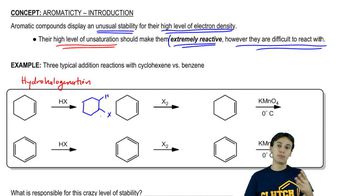
Intro to Aromaticity

Charge Distribution

The stability of charged species, such as cations and anions, is influenced by how well the charge is distributed across the molecule. In the context of aromatic compounds, a positive charge (cation) can be stabilized by resonance, while a negative charge (anion) can also benefit from resonance but may be less stable if it disrupts the aromaticity. Understanding charge distribution helps in predicting which ion is more stable.
Recommended video:
Guided course
01:34
Calculating formal and net charge.

Resonance Structures

Resonance structures are different ways of drawing a molecule that illustrate the delocalization of electrons. For ions in aromatic systems, resonance can significantly affect stability; cations may have resonance forms that distribute the positive charge, enhancing stability, while anions may have resonance forms that can either stabilize or destabilize the negative charge depending on the overall structure. Analyzing resonance is key to determining ion stability.
Recommended video:
Guided course
03:04
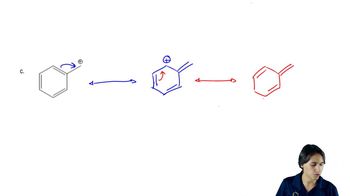
Drawing Resonance Structures