Ch. 7 - The Reactions of Alkynes • An Introduction to Multistep Synthesis
Bruice - Organic Chemistry 8th Edition
Bruice8th EditionOrganic ChemistryISBN: 9780135213711Not the one you use?Change textbook
Chapter 8, Problem 49a

What stereoisomers are obtained when 2-butyne undergoes each of the following reaction sequences?
a. 1. H2/Lindlar catalyst 2. Br2/CH2Cl2

Verified step by step guidance
1
Step 1: Understand the reaction sequence. The first step involves the partial hydrogenation of 2-butyne using H₂ and a Lindlar catalyst. This reaction converts the alkyne into a cis-alkene (Z-alkene) because the Lindlar catalyst selectively adds hydrogen atoms to the same side of the triple bond (syn addition). Write the structure of cis-2-butene as the product of this step.
Step 2: Analyze the second reaction. The product from Step 1 (cis-2-butene) reacts with Br₂ in CH₂Cl₂. This is an electrophilic addition reaction where bromine adds across the double bond of the alkene. The addition of Br₂ to the double bond occurs via an anti-addition mechanism, meaning the bromine atoms add to opposite sides of the double bond.
Step 3: Draw the intermediate bromonium ion. When Br₂ reacts with the double bond, a cyclic bromonium ion intermediate is formed. This intermediate is then attacked by the second bromide ion (Br⁻) from the opposite side, leading to anti-addition.
Step 4: Determine the stereoisomers formed. Since the starting alkene is cis-2-butene, the anti-addition of bromine will result in a pair of enantiomers (optical isomers). These enantiomers are formed because the bromine atoms add to opposite faces of the planar double bond, creating a chiral center at each carbon of the former double bond.
Step 5: Summarize the stereoisomers. The final products of the reaction sequence are a pair of enantiomers of 2,3-dibromobutane. These enantiomers are non-superimposable mirror images of each other, and their structures should be drawn to visualize the stereochemistry.

Verified video answer for a similar problem:

This video solution was recommended by our tutors as helpful for the problem above.
Video duration:
8m
Was this helpful?

Key Concepts

Here are the essential concepts you must grasp in order to answer the question correctly.

Stereoisomerism

Stereoisomerism refers to the phenomenon where compounds have the same molecular formula and connectivity of atoms but differ in the spatial arrangement of those atoms. This can lead to different physical and chemical properties. In the case of alkenes, stereoisomers can be classified as cis or trans, depending on the relative positions of substituents around the double bond.
Recommended video:
Guided course
01:58
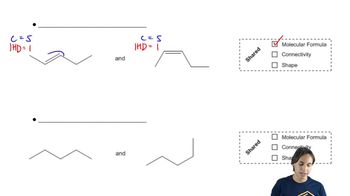
Determining when molecules are stereoisomers.

Hydrogenation with Lindlar Catalyst

Hydrogenation is a chemical reaction that involves the addition of hydrogen (H2) to a compound. When 2-butyne is treated with H2 in the presence of a Lindlar catalyst, it is selectively converted to cis-2-butene. The Lindlar catalyst is a poisoned palladium catalyst that allows for the partial hydrogenation of alkynes to alkenes without further reduction to alkanes.
Recommended video:
Guided course
03:46
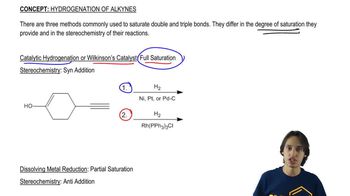
Using Catalytic hydrogenation or Wilkinson’s Catalyst to turn alkynes to alkanes.

Bromination of Alkenes

Bromination is the addition of bromine (Br2) to an alkene, resulting in the formation of vicinal dibromides. When cis-2-butene undergoes bromination in a non-polar solvent like CH2Cl2, it leads to the formation of two stereoisomers: 2,3-dibromobutane. The stereochemistry of the addition can result in both meso and chiral products, depending on the configuration of the starting alkene.
Recommended video:
Guided course
00:54
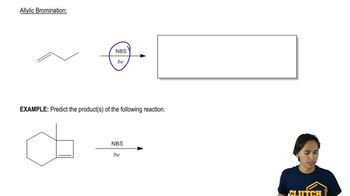
Mechanism of Allylic Bromination.