Ch. 7 - The Reactions of Alkynes • An Introduction to Multistep Synthesis
Bruice - Organic Chemistry 8th Edition
Bruice8th EditionOrganic ChemistryISBN: 9780135213711Not the one you use?Change textbook
Chapter 8, Problem 47

Do the equilibria of the following acid–base reactions lie to the right or the left? (The pKa of H2O2 is 11.6.)
HOOH + HO⇌ HOO+ H2O
RC☰CH + HOO⇌ RC☰C+ HOOH

Verified step by step guidance
1
Step 1: Understand the problem. The question asks whether the equilibrium of each acid-base reaction lies to the right or the left. This depends on the relative acid strengths of the acids on both sides of the reaction, which can be determined using their pKa values. The equilibrium favors the side with the weaker acid (higher pKa).
Step 2: Analyze the first reaction: HOOH + HO⁻ ⇌ HOO⁻ + H₂O. Here, HOOH (hydrogen peroxide) is the acid on the left, and H₂O (water) is the acid on the right. The pKa of HOOH is given as 11.6, and the pKa of H₂O is 15.7. Compare these pKa values to determine which acid is weaker.
Step 3: Analyze the second reaction: RC≡CH + HOO⁻ ⇌ RC≡C⁻ + HOOH. Here, RC≡CH (a terminal alkyne) is the acid on the left, and HOOH (hydrogen peroxide) is the acid on the right. The pKa of a terminal alkyne is approximately 25, and the pKa of HOOH is 11.6. Compare these pKa values to determine which acid is weaker.
Step 4: Use the principle that equilibrium favors the side with the weaker acid (higher pKa). For each reaction, identify whether the equilibrium lies to the right or the left based on the relative pKa values of the acids on both sides.
Step 5: Summarize your findings for both reactions. For the first reaction, compare HOOH and H₂O. For the second reaction, compare RC≡CH and HOOH. State whether the equilibrium lies to the right or the left for each reaction based on the weaker acid.

Verified video answer for a similar problem:

This video solution was recommended by our tutors as helpful for the problem above.
Video duration:
3m
Was this helpful?

Key Concepts

Here are the essential concepts you must grasp in order to answer the question correctly.

Acid-Base Equilibria

Acid-base equilibria refer to the balance between acids and bases in a chemical reaction. The position of equilibrium indicates whether the reactants or products are favored. In general, the equilibrium will lie to the side of the weaker acid and base, which can be determined by comparing their pKa values.
Recommended video:
Guided course
02:49
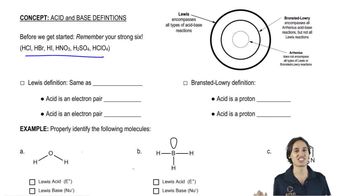
The Lewis definition of acids and bases.

pKa and Strength of Acids

The pKa value is a quantitative measure of the strength of an acid in solution; lower pKa values indicate stronger acids. In the context of acid-base reactions, knowing the pKa of the acids involved helps predict the direction of the equilibrium. For example, if the pKa of H2O2 is 11.6, it suggests that H2O2 is a relatively weak acid.
Recommended video:
Guided course
07:45
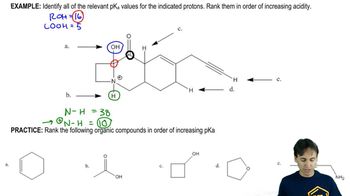
Identifying pKa values

Reaction Mechanism and Stability

The stability of the resulting species in a reaction can influence the position of equilibrium. For instance, the stability of the conjugate base formed after deprotonation can determine whether the equilibrium favors the products or reactants. In the given reactions, analyzing the stability of the alkynyl anion and the hydroperoxide ion is crucial for predicting the direction of the equilibria.
Recommended video:
Guided course
03:43
The radical stability trend.