Ch. 7 - The Reactions of Alkynes • An Introduction to Multistep Synthesis
Bruice - Organic Chemistry 8th Edition
Bruice8th EditionOrganic ChemistryISBN: 9780135213711Not the one you use?Change textbook
Chapter 8, Problem 3a

What is the molecular formula for a monocyclic hydrocarbon with 14 carbons and 2 triple bonds?

Verified step by step guidance
1
Step 1: Recall the general formula for a monocyclic hydrocarbon. A monocyclic hydrocarbon with no double or triple bonds follows the formula CnH2n, where 'n' is the number of carbon atoms.
Step 2: Understand the impact of triple bonds on the hydrogen count. Each triple bond reduces the number of hydrogens by 4 (2 hydrogens per bond).
Step 3: Start with the base formula for a monocyclic hydrocarbon with 14 carbons: C14H28 (using the formula CnH2n).
Step 4: Subtract the hydrogens lost due to the two triple bonds. Since each triple bond reduces the hydrogen count by 4, the total reduction is 4 × 2 = 8 hydrogens.
Step 5: Adjust the molecular formula by subtracting the 8 hydrogens from the original count. The final molecular formula is C14H(28−8).

Verified video answer for a similar problem:

This video solution was recommended by our tutors as helpful for the problem above.
Video duration:
3m
Was this helpful?

Key Concepts

Here are the essential concepts you must grasp in order to answer the question correctly.

Monocyclic Hydrocarbons

Monocyclic hydrocarbons are organic compounds that consist of carbon and hydrogen atoms arranged in a single ring structure. They can be saturated or unsaturated, depending on the presence of double or triple bonds. The general formula for a monocyclic hydrocarbon can vary, but it typically follows the pattern CnH2n for saturated compounds, where 'n' is the number of carbon atoms.
Recommended video:
Guided course
04:52
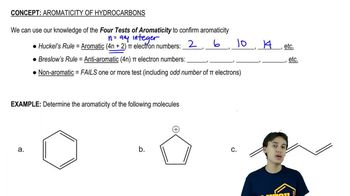
Aromaticity of Hydrocarbons

Triple Bonds in Hydrocarbons

Triple bonds occur when two carbon atoms share three pairs of electrons, resulting in a strong bond that significantly affects the compound's reactivity and stability. In hydrocarbons, the presence of triple bonds reduces the number of hydrogen atoms that can be attached to the carbon skeleton. Each triple bond effectively removes two hydrogen atoms from the molecular formula compared to a saturated hydrocarbon.
Recommended video:
Guided course
06:00
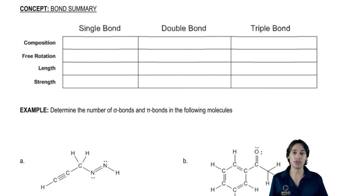
Single bonds, double bonds, and triple bonds.

Determining Molecular Formula

To determine the molecular formula of a hydrocarbon, one must account for the number of carbon (C) and hydrogen (H) atoms based on the structure and types of bonds present. For a monocyclic hydrocarbon with 14 carbons and 2 triple bonds, the formula can be derived by starting with the base formula for saturated hydrocarbons and adjusting for the unsaturation caused by the triple bonds, leading to a final formula that reflects the actual number of hydrogen atoms.
Recommended video:
Guided course
02:17
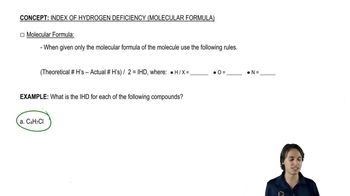
How to use IHD with molecular formula.