Ch. 7 - The Reactions of Alkynes • An Introduction to Multistep Synthesis
Bruice - Organic Chemistry 8th Edition
Bruice8th EditionOrganic ChemistryISBN: 9780135213711Not the one you use?Change textbook
Chapter 8, Problem 4b

Draw the condensed and skeletal structures for each of the following:
b. cyclooctyne

Verified step by step guidance
1
Understand the structure of cyclooctyne: Cyclooctyne is a cyclic alkyne with eight carbon atoms in a ring and a triple bond between two of the carbons. The triple bond introduces linearity between the two carbons involved in the bond.
To draw the condensed structure: Write the molecular formula in a way that represents the connectivity of the atoms. For cyclooctyne, the carbons in the ring are connected in a cyclic manner, and the triple bond is represented as ≡ between two carbons. The condensed structure can be written as C₈H₁₂, with the triple bond explicitly shown.
To draw the skeletal structure: Use a polygon to represent the eight-membered ring, and indicate the triple bond with three parallel lines between two adjacent vertices of the polygon. Remember that in skeletal structures, carbon atoms are implied at the vertices, and hydrogens are not explicitly shown unless necessary.
Ensure the geometry is correct: The triple bond in cyclooctyne introduces strain due to the linear geometry of the bond, which is unusual for a cyclic structure. This should be reflected in the skeletal structure by slightly distorting the ring to accommodate the linearity of the triple bond.
Double-check your drawings: Verify that the condensed structure and skeletal structure both represent the same molecule, with eight carbons in a ring and a triple bond between two of them. Ensure the correct number of hydrogens (12) is accounted for in the condensed structure.

Verified video answer for a similar problem:

This video solution was recommended by our tutors as helpful for the problem above.
Video duration:
4m
Was this helpful?

Key Concepts

Here are the essential concepts you must grasp in order to answer the question correctly.

Cycloalkynes

Cycloalkynes are a class of cyclic hydrocarbons that contain at least one carbon-carbon triple bond within the ring structure. Cyclooctyne, specifically, is an eight-membered ring with a triple bond, which introduces unique strain and reactivity compared to other cycloalkanes. Understanding the geometry and bonding in cycloalkynes is crucial for accurately drawing their structures.
Recommended video:
Guided course
01:11
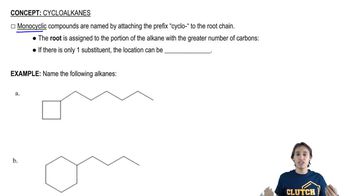
How to find the root name for cycloalkanes

Condensed Structures

Condensed structures are a simplified way of representing molecular structures where bonds are implied rather than explicitly drawn. In condensed formulas, atoms are grouped together to show connectivity without depicting every bond, making it easier to visualize larger molecules. For cyclooctyne, the condensed structure would reflect the cyclic nature and the presence of the triple bond without detailing all individual bonds.
Recommended video:
Guided course
06:06
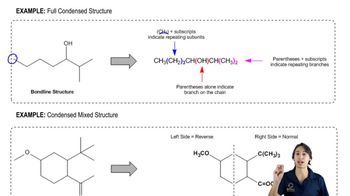
How to interpret condensed structures.

Skeletal Structures

Skeletal structures, or line-angle formulas, are a shorthand representation of organic molecules where carbon atoms are represented by vertices and hydrogen atoms are omitted for clarity. In skeletal drawings, each vertex represents a carbon atom, and the lines between them represent bonds. This method is particularly useful for visualizing complex cyclic structures like cyclooctyne, as it emphasizes the ring and functional groups while simplifying the overall appearance.
Recommended video:
Guided course
04:03
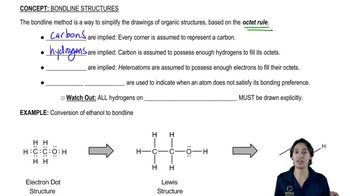
How bondline is different from Lewis Structures.