Textbook Question
a. What alkene is required to synthesize each of the following compounds?
b. What other epoxide is formed in each synthesis?
c. Assign an R or S configuration to each asymmetric center.
2.

 Bruice 8th EditionCh. 6 - The Reactions of Alkenes • The Stereochemistry of Addition ReactionsProblem 42c
 Verified step by step guidance
 01:58
01:58
 06:38
06:38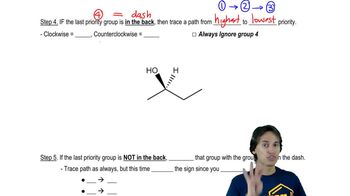 03:07
03:07a. What alkene is required to synthesize each of the following compounds?
b. What other epoxide is formed in each synthesis?
c. Assign an R or S configuration to each asymmetric center.
2.
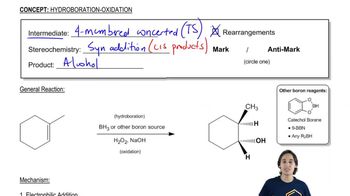
What stereoisomers are obtained from hydroboration–oxidation of the following compounds? Assign an R or S configuration to each asymmetric center.
a. cyclohexene
b. 1-ethylcyclohexene
What stereoisomers are obtained from hydroboration–oxidation of the following compounds? Assign an R or S configuration to each asymmetric center.
d. (Z)-3,4-dimethyl-3-hexene
The reaction of 2-ethyl-1-pentene with Br2, with H2 + Pd/C, or with R2BH/THF followed by aqueous HO- + H2O2 leads to a racemic mixture. Explain why a racemic mixture is obtained in each case.
Using a sample of trans-2-pentene, how could you prove that the addition of Br2 forms a cyclic bromonium ion intermediate rather than a carbocation intermediate?
a. What alkene is required to synthesize each of the following compounds?
b. What other epoxide is formed in each synthesis?
c. Assign an R or S configuration to each asymmetric center.
1.