Ch. 6 - The Reactions of Alkenes • The Stereochemistry of Addition Reactions
Bruice - Organic Chemistry 8th Edition
Bruice8th EditionOrganic ChemistryISBN: 9780135213711Not the one you use?Change textbook
Chapter 7, Problem 41(2)

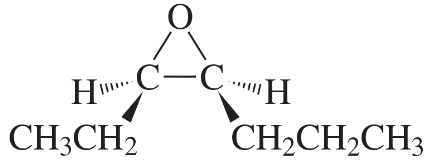
a. What alkene is required to synthesize each of the following compounds?
b. What other epoxide is formed in each synthesis?
c. Assign an R or S configuration to each asymmetric center.
2.

Verified step by step guidance
1
Step 1: Analyze the given epoxide structure. The molecule contains an oxygen atom in a three-membered ring (epoxide) attached to two asymmetric centers. The substituents on the asymmetric centers are CH3CH2 (ethyl group) and CH2CH2CH3 (propyl group).
Step 2: To synthesize this epoxide, identify the alkene precursor. Epoxides are typically formed via the reaction of alkenes with peroxy acids (e.g., mCPBA). The alkene precursor should have the same substituents as the epoxide but without the oxygen atom. In this case, the alkene would be CH3CH=CHCH2CH2CH3.
Step 3: Determine the stereochemistry of the epoxide formation. Epoxidation of alkenes can lead to the formation of two stereoisomers (cis and trans epoxides). The stereochemistry of the alkene precursor will dictate the stereochemistry of the epoxide. If the alkene is cis, the epoxide will be cis; if the alkene is trans, the epoxide will be trans.
Step 4: Identify the other epoxide that could be formed. Since the reaction can produce stereoisomers, the other epoxide would have the opposite stereochemistry at the asymmetric centers. For example, if the given epoxide is (R,R), the other epoxide would be (S,S).
Step 5: Assign R or S configuration to each asymmetric center. Use the Cahn-Ingold-Prelog priority rules to assign the configuration. For each asymmetric center, prioritize the substituents based on atomic number and connectivity, then determine the direction of rotation (clockwise for R, counterclockwise for S).

Verified video answer for a similar problem:

This video solution was recommended by our tutors as helpful for the problem above.
Was this helpful?

Key Concepts

Here are the essential concepts you must grasp in order to answer the question correctly.

Alkene Reactivity

Alkenes are unsaturated hydrocarbons that contain at least one carbon-carbon double bond. Their reactivity is primarily due to this double bond, which can undergo various reactions such as electrophilic addition, oxidation, and polymerization. Understanding the specific alkene required for a synthesis involves recognizing how the double bond can be manipulated to form desired products.
Recommended video:
2:09
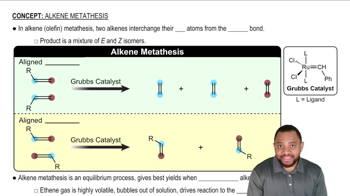
Alkene Metathesis Concept 1

Epoxide Formation

Epoxides are cyclic ethers with a three-membered ring structure that includes an oxygen atom. They are typically formed through the reaction of alkenes with peracids or halohydrins. In the context of synthesis, identifying the epoxide formed is crucial as it can serve as an intermediate in further reactions, influencing the final product's structure and properties.
Recommended video:
Guided course
02:19
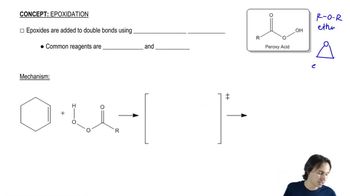
General properties of epoxidation.

Stereochemistry and R/S Configuration

Stereochemistry refers to the spatial arrangement of atoms in molecules and is essential for understanding the properties and reactivity of chiral compounds. The R/S system is a method for assigning configurations to chiral centers based on the Cahn-Ingold-Prelog priority rules. Accurately assigning R or S configurations is vital for predicting the behavior of molecules in reactions and their interactions with biological systems.
Recommended video:
Guided course
03:07
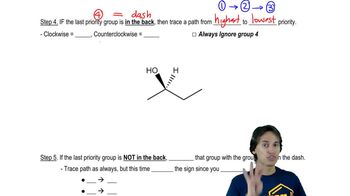
R and S Naming- Step 4