Ch. 6 - The Reactions of Alkenes • The Stereochemistry of Addition Reactions
Bruice - Organic Chemistry 8th Edition
Bruice8th EditionOrganic ChemistryISBN: 9780135213711Not the one you use?Change textbook
Chapter 7, Problem 66g

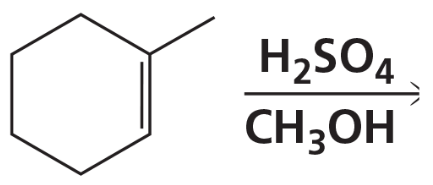
What is the major product of each of the following reactions?
g.

Verified step by step guidance
1
Step 1: Analyze the given reaction conditions. The reactant is a substituted cyclohexene, and the reagents are H2SO4 (sulfuric acid) and CH3OH (methanol). This indicates an electrophilic addition reaction, where the alkene will react with the acidic medium and methanol to form an ether product.
Step 2: Identify the mechanism. The reaction proceeds via protonation of the double bond by H2SO4, forming a carbocation intermediate. The stability of the carbocation is crucial in determining the major product.
Step 3: Determine the most stable carbocation. The double bond in the cyclohexene will be protonated, and the carbocation will form at the more substituted carbon (due to hyperconjugation and inductive effects). In this case, the carbocation forms at the carbon adjacent to the ethyl group.
Step 4: Nucleophilic attack by methanol. Methanol (CH3OH) acts as a nucleophile and attacks the carbocation, forming a new bond between the oxygen atom of methanol and the carbocation center.
Step 5: Final step - deprotonation. The protonated ether intermediate loses a proton to regenerate the acidic medium (H2SO4), resulting in the formation of the major product, which is an ether with the methoxy group (-OCH3) attached to the more substituted carbon of the original double bond.

Verified video answer for a similar problem:

This video solution was recommended by our tutors as helpful for the problem above.
Video duration:
4m
Was this helpful?

Key Concepts

Here are the essential concepts you must grasp in order to answer the question correctly.

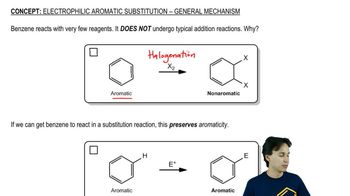
Electrophilic Aromatic Substitution (EAS)

Electrophilic Aromatic Substitution is a fundamental reaction mechanism in organic chemistry where an electrophile replaces a hydrogen atom on an aromatic ring. This process is crucial for understanding how substituents can modify the reactivity and properties of aromatic compounds. In the context of the given reaction, the aromatic ring undergoes substitution with a methoxy group, facilitated by the presence of sulfuric acid as a catalyst.
Recommended video:

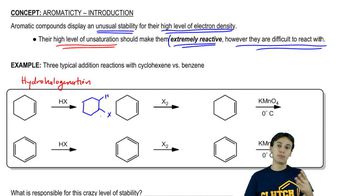
Reactivity of Aromatic Compounds

Aromatic compounds exhibit unique reactivity due to their stable resonance structures. The presence of electron-donating or electron-withdrawing groups on the aromatic ring can significantly influence the position and rate of substitution reactions. In this case, the alkyl groups attached to the benzene ring are electron-donating, which enhances the reactivity of the ring towards electrophiles, guiding the formation of the major product.
Recommended video:
Guided course
08:19
Intro to Aromaticity

Role of Catalysts in Organic Reactions

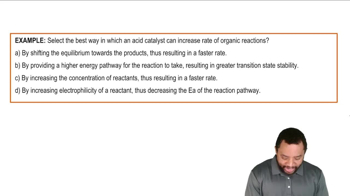
Catalysts, such as sulfuric acid in this reaction, are substances that increase the rate of a chemical reaction without being consumed in the process. In electrophilic aromatic substitution, catalysts help generate a more reactive electrophile, facilitating the substitution process. Understanding the role of catalysts is essential for predicting the outcome of reactions and optimizing conditions for desired products.
Recommended video:
1:22
Introduction to Catalysis Example 1