Ch. 6 - The Reactions of Alkenes • The Stereochemistry of Addition Reactions
Bruice - Organic Chemistry 8th Edition
Bruice8th EditionOrganic ChemistryISBN: 9780135213711Not the one you use?Change textbook
Chapter 7, Problem 66b

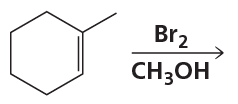
What is the major product of each of the following reactions?
b. Benzene ring reacting with bromine and methanol, illustrating a halohydrin formation reaction.

Verified step by step guidance
1
Step 1: Analyze the structure of the reactant. The molecule is a substituted cyclohexene with a double bond. The reaction involves bromine (Br₂) in methanol (CH₃OH), which suggests a bromination reaction in the presence of a nucleophile (methanol).
Step 2: Understand the mechanism. Bromine reacts with the double bond via electrophilic addition. The π-electrons of the double bond attack Br₂, forming a bromonium ion intermediate.
Step 3: Consider the role of methanol. Methanol acts as a nucleophile and will attack the more substituted carbon of the bromonium ion due to steric and electronic factors, leading to regioselectivity.
Step 4: Predict the stereochemistry. The attack by methanol occurs from the opposite side of the bromonium ion (anti-addition), resulting in a trans product.
Step 5: Draw the major product. The major product will have a bromine atom and a methoxy group (-OCH₃) added across the double bond in an anti configuration, with the methoxy group on the more substituted carbon.

Verified video answer for a similar problem:

This video solution was recommended by our tutors as helpful for the problem above.
Video duration:
4m
Was this helpful?

Key Concepts

Here are the essential concepts you must grasp in order to answer the question correctly.

Electrophilic Addition Reactions

Electrophilic addition reactions involve the addition of an electrophile to a nucleophile, typically across a double bond. In the case of alkenes, such as cyclohexene, the π bond acts as a nucleophile, reacting with electrophiles like Br2. This reaction leads to the formation of a more stable product, often resulting in the addition of halogens across the double bond.
Recommended video:
Guided course
05:39
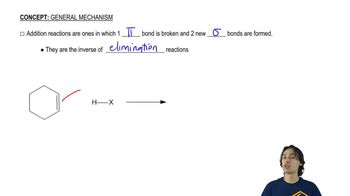
Features of Addition Mechanisms.

Regioselectivity

Regioselectivity refers to the preference of a chemical reaction to yield one structural isomer over others when multiple possibilities exist. In the bromination of cyclohexene, the regioselectivity is influenced by the stability of the carbocation intermediates formed during the reaction. Understanding which carbon atoms are more favorable for electrophilic attack is crucial for predicting the major product.
Recommended video:
Guided course
05:09
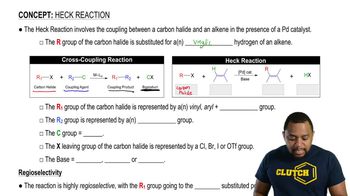
Heck Reaction

Solvent Effects

The choice of solvent can significantly influence the outcome of a chemical reaction. In this case, methanol (CH3OH) serves as a polar protic solvent, which can stabilize charged intermediates and facilitate the reaction. The solvent can also participate in the reaction, potentially leading to the formation of products that include methanol-derived groups, such as methoxy groups, in the final product.
Recommended video:
Guided course
01:16
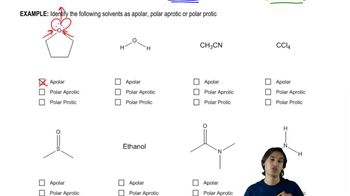
Identification of polarity in solvents