Ch. 6 - The Reactions of Alkenes • The Stereochemistry of Addition Reactions
Bruice - Organic Chemistry 8th Edition
Bruice8th EditionOrganic ChemistryISBN: 9780135213711Not the one you use?Change textbook
Chapter 7, Problem 35

What characteristics must the reactant of a stereospecific reaction have?

Verified step by step guidance
1
A stereospecific reaction is one in which the stereochemistry of the reactant determines the stereochemistry of the product. To understand this, we need to analyze the characteristics of the reactant.
The reactant must have a stereocenter or a specific geometric arrangement that can influence the outcome of the reaction. For example, it could be a molecule with a chiral center or a double bond with cis/trans (E/Z) isomerism.
The reactant must be capable of undergoing a reaction mechanism that preserves or transforms its stereochemical configuration in a predictable way. For instance, in an SN2 reaction, the configuration at the stereocenter is inverted due to the backside attack of the nucleophile.
The reactant must not have free rotation around bonds that would randomize its stereochemistry before the reaction occurs. For example, in alkenes, the double bond restricts rotation, preserving the E/Z configuration.
The reactant's stereochemistry must directly influence the stereochemistry of the product. This means that the reaction pathway must be selective for one stereoisomer over another, ensuring a specific stereochemical outcome.

Verified video answer for a similar problem:

This video solution was recommended by our tutors as helpful for the problem above.
Video duration:
4m
Was this helpful?

Key Concepts

Here are the essential concepts you must grasp in order to answer the question correctly.

Stereospecificity

Stereospecificity refers to a type of reaction where the reactants lead to a specific stereoisomer of the product. In stereospecific reactions, the configuration of the reactant determines the configuration of the product, meaning that different stereoisomers of the reactant will yield different stereoisomers of the product. This characteristic is crucial for understanding how molecular structure influences reaction outcomes.
Recommended video:
Guided course
15:39
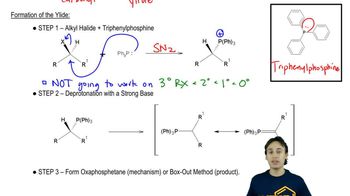
Box-Out Method and Full-Mechanism

Reactant Structure

The structure of the reactant plays a vital role in stereospecific reactions. Reactants must possess certain functional groups or stereocenters that can influence the spatial arrangement of atoms during the reaction. For a reaction to be stereospecific, the reactant must have a defined stereochemistry that can direct the formation of a specific stereoisomer in the product.
Recommended video:
Guided course
03:04
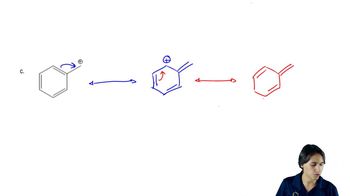
Drawing Resonance Structures

Mechanism of Reaction

The mechanism of a reaction outlines the step-by-step process by which reactants transform into products. In stereospecific reactions, the mechanism often involves specific pathways that preserve or dictate stereochemistry. Understanding the mechanism helps in predicting the outcome of the reaction and the characteristics that the reactants must possess to ensure a stereospecific result.
Recommended video:
Guided course
02:16
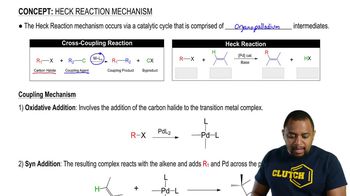
Heck Reaction Mechanism