Ch. 6 - The Reactions of Alkenes • The Stereochemistry of Addition Reactions
Bruice - Organic Chemistry 8th Edition
Bruice8th EditionOrganic ChemistryISBN: 9780135213711Not the one you use?Change textbook
Chapter 7, Problem 36a,b,c

a. Is the reaction of 2-butene with HBr regioselective?
b. Is it stereoselective?
c. Is it stereospecific?

Verified step by step guidance
1
To determine if the reaction of 2-butene with HBr is regioselective, analyze the mechanism of the reaction. The addition of HBr to an alkene follows Markovnikov's rule, where the hydrogen atom adds to the carbon with more hydrogens (less substituted), and the bromine adds to the carbon with fewer hydrogens (more substituted). This creates a regioselective product.
To assess if the reaction is stereoselective, consider the formation of the carbocation intermediate. The planar nature of the carbocation allows the bromide ion to attack from either side, leading to the formation of a racemic mixture (if the product is chiral). This indicates that the reaction is not stereoselective.
To evaluate if the reaction is stereospecific, recall that stereospecificity refers to a reaction where a specific stereoisomer of the reactant leads to a specific stereoisomer of the product. Since the addition of HBr to 2-butene does not depend on the stereochemistry of the starting material (cis- or trans-2-butene), the reaction is not stereospecific.
Summarize the findings: (a) The reaction is regioselective due to Markovnikov's rule. (b) The reaction is not stereoselective because it forms a racemic mixture. (c) The reaction is not stereospecific because the stereochemistry of the starting material does not dictate the stereochemistry of the product.
For further understanding, consider drawing the reaction mechanism step by step, showing the formation of the carbocation intermediate and the subsequent attack by the bromide ion. This will help visualize why the reaction is regioselective but not stereoselective or stereospecific.

Verified video answer for a similar problem:

This video solution was recommended by our tutors as helpful for the problem above.
Video duration:
6m
Was this helpful?

Key Concepts

Here are the essential concepts you must grasp in order to answer the question correctly.

Regioselectivity

Regioselectivity refers to the preference of a chemical reaction to yield one structural isomer over others when multiple isomers are possible. In the case of the reaction of 2-butene with HBr, regioselectivity is determined by the stability of the carbocation intermediates formed during the reaction. The more stable carbocation will lead to the major product, illustrating the concept of regioselectivity.
Recommended video:
Guided course
05:09
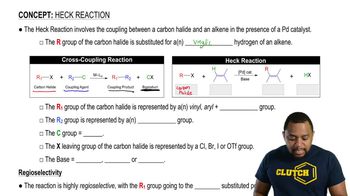
Heck Reaction

Stereoselectivity

Stereoselectivity describes a reaction's ability to preferentially form one stereoisomer over another when multiple stereoisomers can be produced. In the context of the reaction of 2-butene with HBr, stereoselectivity can be assessed by examining whether the addition of HBr leads to a predominant formation of either the cis or trans product. This concept is crucial for understanding the spatial arrangement of atoms in the resulting molecules.

Stereospecificity

Stereospecificity is a more stringent condition than stereoselectivity, indicating that the reaction mechanism leads to a specific stereoisomer based on the stereochemistry of the reactant. In the reaction of 2-butene with HBr, if the addition of HBr to one stereoisomer of 2-butene produces a specific product while the other stereoisomer yields a different product, the reaction is considered stereospecific. This concept highlights the relationship between the structure of reactants and the resulting products.
Recommended video:
Guided course
15:39
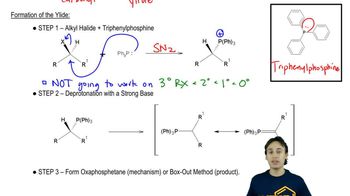
Box-Out Method and Full-Mechanism