Ch. 6 - The Reactions of Alkenes • The Stereochemistry of Addition Reactions
Bruice - Organic Chemistry 8th Edition
Bruice8th EditionOrganic ChemistryISBN: 9780135213711Not the one you use?Change textbook
Chapter 7, Problem 94a

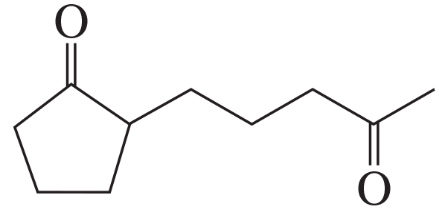
What alkene gives the product shown after reaction first with ozone and then with dimethyl sulfide?
a.

Verified step by step guidance
1
Step 1: Understand the reaction mechanism. Ozonolysis is a reaction where an alkene reacts with ozone (O₃) to form an ozonide intermediate. This intermediate is then reduced by dimethyl sulfide (DMS) to yield carbonyl compounds (aldehydes or ketones).
Step 2: Analyze the product structure provided in the image. The product contains two carbonyl groups: one is a ketone (on the right side) and the other is a cyclic ketone (on the left side). This suggests that the original alkene was cleaved into these two fragments.
Step 3: Determine the original alkene structure. To reverse-engineer the alkene, connect the two carbonyl carbons from the product structure with a double bond. This double bond represents the original alkene that underwent ozonolysis.
Step 4: Verify the connectivity. Ensure that the carbon chain and substituents in the reconstructed alkene match the product fragments after cleavage. The cyclic ketone indicates that one part of the alkene was part of a ring structure.
Step 5: Draw the alkene structure. Based on the analysis, the original alkene should have a double bond connecting the carbon of the cyclic structure to the carbon of the linear chain leading to the second ketone group.

Verified video answer for a similar problem:

This video solution was recommended by our tutors as helpful for the problem above.
Video duration:
56s
Was this helpful?

Key Concepts

Here are the essential concepts you must grasp in order to answer the question correctly.

Ozonolysis

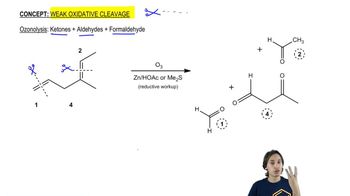
Ozonolysis is a reaction involving the cleavage of alkenes using ozone (O3) to form carbonyl compounds, such as aldehydes and ketones. The process typically occurs in two steps: first, the alkene reacts with ozone to form a molozonide, which rearranges to a more stable ozonide. This ozonide is then reduced, often using a reagent like dimethyl sulfide (DMS), to yield the final carbonyl products.
Recommended video:
Guided course
06:30
General properties of ozonolysis.

Alkene Structure

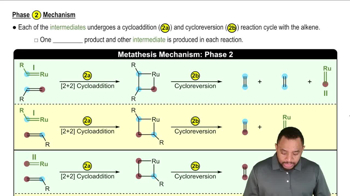
Alkenes are hydrocarbons that contain at least one carbon-carbon double bond (C=C). The structure of the alkene, including the position and substitution of the double bond, significantly influences the products formed during reactions like ozonolysis. Understanding the specific alkene structure is crucial for predicting the resulting carbonyl compounds after ozonolysis.
Recommended video:
1:59
Alkene Metathesis Concept 5

Dimethyl Sulfide (DMS) as a Reducing Agent

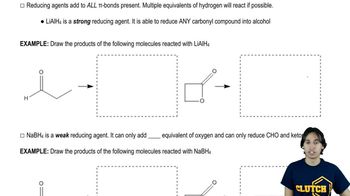
Dimethyl sulfide (DMS) is commonly used as a reducing agent in organic chemistry, particularly in the reduction of ozonides formed during ozonolysis. DMS facilitates the conversion of the ozonide into stable carbonyl compounds by donating electrons, effectively breaking the unstable ozonide bond. This step is essential for obtaining the final products from the initial alkene.
Recommended video:
Guided course
09:28
Reducing Agents