Textbook Question
Dichlorocarbene can also be generated by heating sodium trichloroacetate. Propose a mechanism for the reaction.
1
views

 Bruice 8th EditionCh. 6 - The Reactions of Alkenes • The Stereochemistry of Addition ReactionsProblem 90
 Verified step by step guidance
 2:09
2:09
 07:37
07:37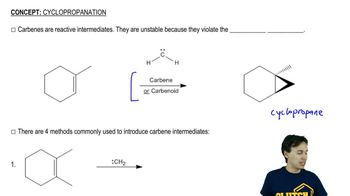 01:49
01:49Dichlorocarbene can also be generated by heating sodium trichloroacetate. Propose a mechanism for the reaction.
Draw the products of the following reactions. If the products can exist as stereoisomers show what stereoisomers are formed.
k. (Z)-3,4-dimethyl-3-hexene + H2, Pd/C
l. (E)-3,4-dimethyl-3-hexene + H2, Pd/C
What alkene gives the product shown after reaction first with ozone and then with dimethyl sulfide?
a.
A, a compound with molecular formula C6H10, contains three methylene units. A reacts with one equivalent of H2 over Pd/C to yield B. A reacts with aqueous acid to form a single product, C, and undergoes hydroboration/oxidation to form a pair of enantiomers, D and E. Ozonolysis of A followed by reaction with dimethyl sulfide forms F with molecular formula C6H10O2. Provide structures for A–F.
Of the possible products shown for the following reaction, are there any that will not be formed?
Two chemists at Dupont found that ICH2ZnI is better than diazomethane at converting a C=C bond to a cylcopropane ring. Propose a mechanism for the reaction, now known as the Simmons–Smith reaction in their honor.