Ch. 6 - The Reactions of Alkenes • The Stereochemistry of Addition Reactions
Bruice - Organic Chemistry 8th Edition
Bruice8th EditionOrganic ChemistryISBN: 9780135213711Not the one you use?Change textbook
Chapter 7, Problem 85a

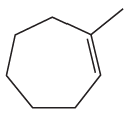
For each compound, show the products obtained from ozonolysis, followed by treatment with dimethyl sulfide.
a. Chemical structure of a cyclic compound illustrating ozonolysis products and subsequent treatment with dimethyl sulfide.

Verified step by step guidance
1
Step 1: Identify the functional group in the compound. The given structure is a cyclohexene, which contains a double bond within a six-membered ring.
Step 2: Understand the reaction mechanism. Ozonolysis involves the cleavage of the double bond by ozone (O₃), forming an ozonide intermediate. This intermediate is then treated with dimethyl sulfide (DMS, (CH₃)₂S), which reduces the ozonide to carbonyl compounds.
Step 3: Locate the double bond in the structure. The double bond in cyclohexene is between two adjacent carbon atoms in the ring.
Step 4: Predict the cleavage products. The double bond will split, and each carbon involved in the double bond will form a carbonyl group (either an aldehyde or ketone). For cyclohexene, this results in two molecules of formaldehyde (CH₂O).
Step 5: Summarize the reaction. After ozonolysis and treatment with dimethyl sulfide, the products are two carbonyl compounds derived from the cleavage of the double bond. In this case, the products are formaldehyde molecules.

Verified video answer for a similar problem:

This video solution was recommended by our tutors as helpful for the problem above.
Video duration:
5m
Was this helpful?

Key Concepts

Here are the essential concepts you must grasp in order to answer the question correctly.

Ozonolysis

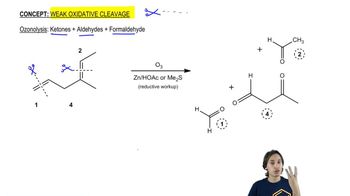
Ozonolysis is a reaction involving the cleavage of alkenes or alkynes using ozone (O3) to form carbonyl compounds, such as aldehydes and ketones. The reaction typically occurs in two steps: first, the alkene reacts with ozone to form a molozonide, which rearranges to form ozonide. This ozonide can then be hydrolyzed or treated with a reducing agent to yield the final carbonyl products.
Recommended video:
Guided course
06:30
General properties of ozonolysis.

Dimethyl Sulfide (DMS) Treatment

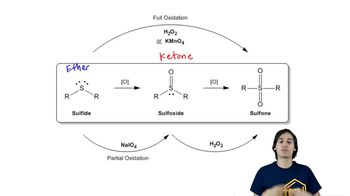
Dimethyl sulfide (DMS) is often used as a reducing agent in organic chemistry, particularly in the context of ozonolysis. After the initial ozonolysis step, DMS can reduce the ozonide intermediate to yield aldehydes or ketones, effectively converting the carbonyl compounds into more stable products. This step is crucial for preventing the formation of unwanted byproducts and for achieving the desired carbonyl compounds.
Recommended video:
Guided course
03:51
Reagents used to oxidize Sulfides.

Cyclohexene Structure

Cyclohexene is a cyclic alkene with a six-membered carbon ring and one double bond. Its structure is significant in ozonolysis as the position of the double bond influences the products formed during the reaction. Understanding the geometry and reactivity of cyclohexene is essential for predicting the outcome of ozonolysis and subsequent treatment with DMS, as it determines how the molecule will cleave and what functional groups will be generated.
Recommended video:
Guided course
03:04
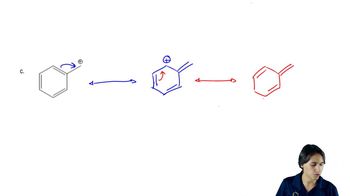
Drawing Resonance Structures