Ch. 6 - The Reactions of Alkenes • The Stereochemistry of Addition Reactions
Bruice - Organic Chemistry 8th Edition
Bruice8th EditionOrganic ChemistryISBN: 9780135213711Not the one you use?Change textbook
Chapter 7, Problem 85c

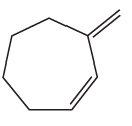
For each compound, show the products obtained from ozonolysis, followed by treatment with dimethyl sulfide.
c. Chemical structure of a cyclic compound illustrating ozonolysis products and subsequent treatment with dimethyl sulfide.

Verified step by step guidance
1
Step 1: Identify the double bonds in the compound. The given structure is a bicyclic compound with two double bonds: one in the six-membered ring and one exocyclic double bond.
Step 2: Understand the ozonolysis reaction. Ozonolysis involves the cleavage of double bonds using ozone (O₃), followed by reductive workup with dimethyl sulfide (DMS). Each double bond is cleaved to form carbonyl compounds.
Step 3: Predict the cleavage products for the exocyclic double bond. The exocyclic double bond will split into two fragments: one fragment will be a ketone, and the other will be a formaldehyde molecule.
Step 4: Predict the cleavage products for the double bond in the ring. The double bond within the six-membered ring will split into two carbonyl compounds, likely two ketones or aldehydes depending on the substituents.
Step 5: Combine the products from both cleavages. The final products will include the carbonyl compounds formed from both the exocyclic and ring double bonds. Ensure you account for all fragments generated during the reaction.

Verified video answer for a similar problem:

This video solution was recommended by our tutors as helpful for the problem above.
Video duration:
6m
Was this helpful?

Key Concepts

Here are the essential concepts you must grasp in order to answer the question correctly.

Ozonolysis

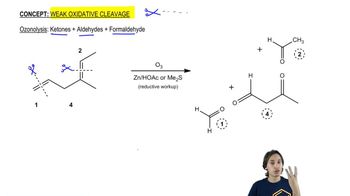
Ozonolysis is a reaction involving the cleavage of alkenes or alkynes using ozone (O3) to form carbonyl compounds, such as aldehydes and ketones. The reaction typically occurs in two steps: first, the alkene reacts with ozone to form a molozonide, which rearranges to form ozonide. The ozonide is then hydrolyzed or treated with a reducing agent to yield the final carbonyl products.
Recommended video:
Guided course
06:30
General properties of ozonolysis.

Dimethyl Sulfide (DMS) Treatment

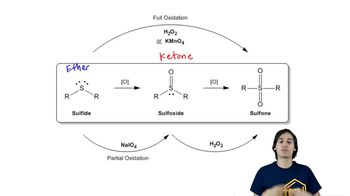
Dimethyl sulfide (DMS) is often used as a reducing agent in organic chemistry, particularly following ozonolysis. After ozonolysis, the carbonyl compounds can be further reduced to their corresponding alcohols or other derivatives when treated with DMS. This step is crucial for converting the ozonolysis products into more stable or functionalized compounds.
Recommended video:
Guided course
03:51
Reagents used to oxidize Sulfides.

Mechanism of Ozonolysis

The mechanism of ozonolysis involves the formation of a cyclic ozonide intermediate, which is unstable and undergoes cleavage to yield carbonyl compounds. Understanding this mechanism is essential for predicting the products of ozonolysis, as the position of the double bond and the structure of the starting alkene influence the resulting carbonyls. This knowledge is vital for accurately determining the products when analyzing the reaction.
Recommended video:
Guided course
06:30
General properties of ozonolysis.