

Ch. 6 - The Reactions of Alkenes • The Stereochemistry of Addition Reactions
Bruice - Organic Chemistry 8th Edition
Bruice8th EditionOrganic ChemistryISBN: 9780135213711Not the one you use?Change textbook
Chapter 7, Problem 69b

Draw a reaction coordinate diagram for the reaction. (Hint: An alkyl halide is more stable than an alkene.)
Reaction coordinate diagram illustrating the stability of an alkyl halide compared to an alkene during a chemical reaction.

Verified step by step guidance
1
Step 1: Understand the reaction mechanism. The reaction involves the addition of HBr to an alkene, resulting in the formation of an alkyl halide. The alkene undergoes electrophilic addition, where the π electrons attack the proton (H⁺) from HBr, forming a carbocation intermediate.
Step 2: Identify the stability of intermediates. The carbocation formed during the reaction is stabilized by hyperconjugation and inductive effects from adjacent alkyl groups. The more substituted the carbocation, the more stable it is.
Step 3: Analyze the energy changes. The reaction coordinate diagram will have an initial energy level corresponding to the reactants (alkene and HBr). The energy rises to a peak representing the transition state for the formation of the carbocation intermediate. The intermediate is at a lower energy level than the transition state but higher than the reactants.
Step 4: Consider the final product stability. The alkyl halide product is more stable than the alkene reactant due to the strong C-Br bond and the absence of a reactive π bond. The energy level of the product will be lower than that of the reactants.
Step 5: Draw the reaction coordinate diagram. Plot the energy on the y-axis and the reaction progress on the x-axis. Include the reactants, transition state, intermediate, and product. Label the energy levels and indicate the relative stability of each species.

Verified video answer for a similar problem:

This video solution was recommended by our tutors as helpful for the problem above.
Video duration:
6m
Was this helpful?

Key Concepts

Here are the essential concepts you must grasp in order to answer the question correctly.

Reaction Coordinate Diagram

A reaction coordinate diagram is a graphical representation that illustrates the energy changes during a chemical reaction. It plots the energy of the system against the progress of the reaction, showing the transition states, intermediates, and the overall energy difference between reactants and products. Understanding this diagram helps visualize the stability of different species involved in the reaction.
Recommended video:
Guided course
05:02
Coordination Complexes

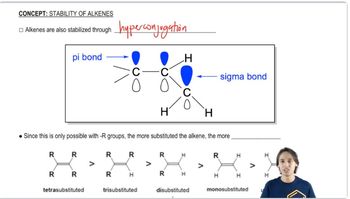
Stability of Alkyl Halides vs. Alkenes

Alkyl halides are generally more stable than alkenes due to the presence of a halogen atom, which can stabilize the molecule through inductive effects and hyperconjugation. This stability influences the reaction pathway and the energy profile depicted in the reaction coordinate diagram, as more stable intermediates typically lead to lower activation energy and more favorable reaction conditions.
Recommended video:
Guided course
04:28
Understanding trends of alkene stability.

Mechanism of Electrophilic Addition

The mechanism of electrophilic addition involves the reaction of an electrophile with a nucleophile, leading to the formation of a carbocation intermediate. In the context of the provided reaction, the alkene acts as a nucleophile, attacking the electrophilic hydrogen in HBr, resulting in a carbocation that can further react with bromide ions. Understanding this mechanism is crucial for predicting the products and the energy changes during the reaction.
Recommended video:
Guided course
05:39
Features of Addition Mechanisms.