

Ch. 6 - The Reactions of Alkenes • The Stereochemistry of Addition Reactions
Bruice - Organic Chemistry 8th Edition
Bruice8th EditionOrganic ChemistryISBN: 9780135213711Not the one you use?Change textbook
Chapter 7, Problem 69a

Use curved arrows to show the flow of electrons that occurs in each step of the following mechanism
Curved arrows illustrate the electron flow in a chemical reaction mechanism involving hydrogen and bromine.

Verified step by step guidance
1
Step 1: Identify the electrophile and nucleophile in the reaction. In this case, HBr acts as the electrophile, with the hydrogen atom being electron-deficient, and the alkene acts as the nucleophile due to the π-electrons in the double bond.
Step 2: Use a curved arrow to show the flow of electrons from the π-bond of the alkene to the hydrogen atom of HBr. This forms a new bond between the hydrogen and one of the carbon atoms in the double bond, breaking the π-bond.
Step 3: As the π-electrons move to bond with hydrogen, the bond between hydrogen and bromine in HBr breaks. Use a curved arrow to show the flow of electrons from the H-Br bond to bromine, resulting in the formation of a bromide ion (Br⁻).
Step 4: The carbon atom that does not bond with hydrogen becomes a carbocation (positively charged). This carbocation is stabilized by the surrounding alkyl groups through hyperconjugation and inductive effects.
Step 5: Use a curved arrow to show the flow of electrons from the lone pair on the bromide ion (Br⁻) to the carbocation. This forms a new bond between the bromine atom and the positively charged carbon, completing the addition reaction.

Verified video answer for a similar problem:

This video solution was recommended by our tutors as helpful for the problem above.
Video duration:
4m
Was this helpful?

Key Concepts

Here are the essential concepts you must grasp in order to answer the question correctly.

Curved Arrows in Mechanisms

Curved arrows are used in organic chemistry to represent the movement of electrons during chemical reactions. The tail of the arrow indicates the electron source, while the head points to the electron destination. This notation helps visualize the flow of electrons, which is crucial for understanding reaction mechanisms, including nucleophilic attacks and electrophilic additions.
Recommended video:
Guided course
04:32
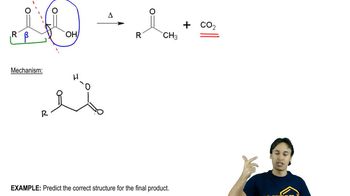
General Mechanism

Acid-Base Reactions

Acid-base reactions involve the transfer of protons (H+) between reactants. In the context of the provided mechanism, a Brønsted acid donates a proton to a base, leading to the formation of a conjugate acid and a conjugate base. Understanding the roles of acids and bases is essential for predicting the outcome of reactions and the stability of intermediates.
Recommended video:
Guided course
02:49
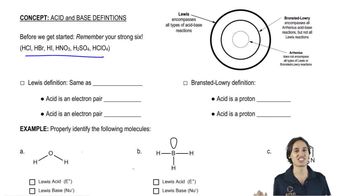
The Lewis definition of acids and bases.

Electrophiles and Nucleophiles

Electrophiles are electron-deficient species that seek electrons, while nucleophiles are electron-rich species that donate electrons. In the mechanism shown, the bromine molecule acts as an electrophile, and the alkene acts as a nucleophile. Recognizing these roles is vital for predicting how molecules will interact and react in organic reactions.
Recommended video:
Guided course
03:
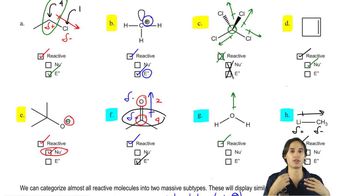
Nucleophile or Electrophile