
Ch. 5 - Alkenes: Structure, Nomenclature, and an Introduction to Reactivity • Thermodynamics and Kinetics
Bruice - Organic Chemistry 8th Edition
Bruice8th EditionOrganic ChemistryISBN: 9780135213711Not the one you use?Change textbook
Chapter 6, Problem 64

Given that the free energy of the twist-boat conformer of cyclohexane is 5.3 kcal/mol greater than that of the chair conformer, calculate the percentage of twist-boat conformers present in a sample of cyclohexane at 25 °C. Does your answer agree with the statement made in Section 3.13 about the relative number of molecules in these two conformations?

Verified step by step guidance
1
Step 1: Recall the relationship between free energy difference (ΔG) and the equilibrium constant (K) using the equation: ΔG=-RTln(K), where R is the gas constant (1.987 cal/(mol·K)), T is the temperature in Kelvin, and K is the equilibrium constant.
Step 2: Convert the temperature from Celsius to Kelvin. Add 273.15 to the given temperature of 25 °C to get T = 298.15 K.
Step 3: Rearrange the equation to solve for K, the equilibrium constant: K=e^(-ΔG/(RT)). Substitute ΔG = 5.3 kcal/mol (convert to cal/mol: 5.3 × 1000 = 5300 cal/mol), R = 1.987 cal/(mol·K), and T = 298.15 K into the equation.
Step 4: Once K is calculated, recall that K represents the ratio of the concentrations of the two conformers: K=[Chair]/[TwistBoat]. Rearrange to find the percentage of twist-boat conformers: [TwistBoat]=(1/(1+K))×100.
Step 5: Compare the calculated percentage of twist-boat conformers to the statement in Section 3.13. If the percentage is very small, it agrees with the statement that the chair conformer is overwhelmingly more stable and predominant in a sample of cyclohexane.

Verified video answer for a similar problem:

This video solution was recommended by our tutors as helpful for the problem above.
Video duration:
11m
Was this helpful?

Key Concepts

Here are the essential concepts you must grasp in order to answer the question correctly.

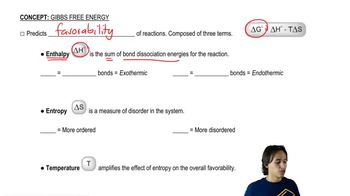
Gibbs Free Energy

Gibbs Free Energy (G) is a thermodynamic potential that measures the maximum reversible work obtainable from a thermodynamic system at constant temperature and pressure. The difference in free energy between two states indicates the favorability of one state over another. In this context, the twist-boat conformer of cyclohexane is less stable than the chair conformer due to its higher free energy, which affects the distribution of conformers at equilibrium.
Recommended video:
Guided course
05:02
Breaking down the different terms of the Gibbs Free Energy equation.

Boltzmann Distribution

The Boltzmann Distribution describes the distribution of particles among various energy states in a system at thermal equilibrium. It states that the ratio of the number of particles in two states is proportional to the exponential of the negative energy difference between the states divided by the product of the Boltzmann constant and temperature. This concept is crucial for calculating the percentage of molecules in different conformations based on their free energy differences.
Recommended video:
1:04
EAS Reactions of Pyridine Example 2

Conformational Analysis

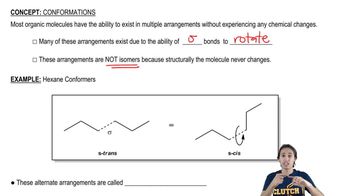
Conformational analysis involves studying the different spatial arrangements of atoms in a molecule that can be interconverted by rotation around single bonds. In cyclohexane, the chair and twist-boat conformers represent different energy states, with the chair being the most stable. Understanding these conformations helps predict the behavior and properties of cyclohexane in various conditions, including its distribution at a given temperature.
Recommended video:
Guided course
03:29
Understanding what a conformer is.